

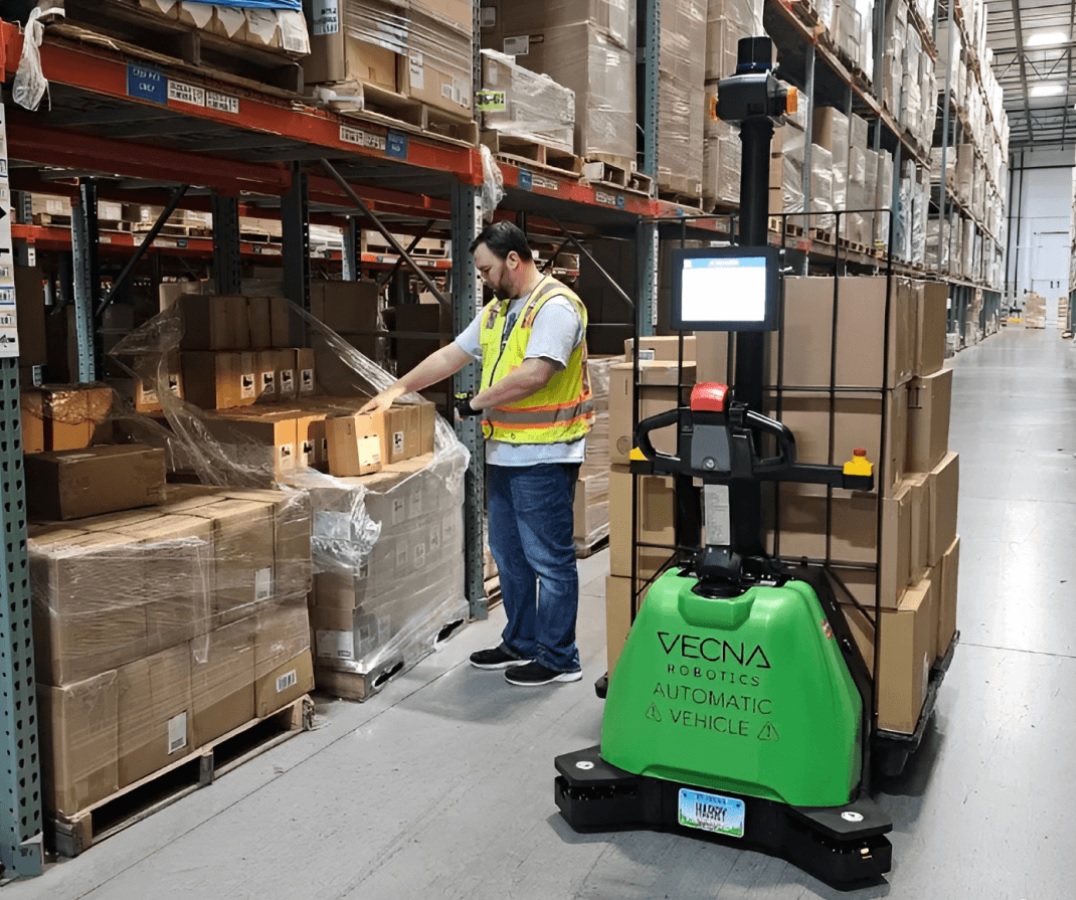
Vecna Robotics has raised $31 million to expand its warehouse robotics business and develop new capabilities intended to move autonomous pallet handling deeper into storage, staging and loading-dock operations.
The financing was led by Unless, with existing investors Drive Capital, Tiger Global, Highland Capital Partners and Tectonic Ventures also participating.
For warehouse operators, the more consequential part of the announcement is what Vecna intends to add to its robots.
The company plans to develop pallet stacking and de-stacking as well as trailer loading and unloading, extending beyond the autonomous pallet movement already handled by its existing systems.
If successfully commercialized, those functions would allow Vecna to address more consecutive stages of pallet flow rather than automating individual transport moves between fixed points.
Vecna describes that objective as dock-to-dock automation. It is not there yet.
The company has not announced a production warehouse where its robots are autonomously completing the entire sequence from trailer unloading through storage and staging to outbound trailer loading. Nor has it disclosed when the new stacking or trailer-handling functions will become commercially available.
The distinction is important because Vecna already has an established portfolio of autonomous material-handling equipment.
Its current offerings include a Co-bot Pallet Jack, autonomous forklift and autonomous tugger, alongside CaseFlow for case-picking operations.
Those systems can automate pallet transportation and other material movements inside warehouses. The newly funded development program is intended to expand the physical tasks the robotic fleet can perform.
Trailer interaction represents a particularly significant step in that progression.
A broader dock-to-dock workflow could potentially connect unloading, receiving and staging movements with putaway, internal pallet transport, outbound staging and loading.
Only portions of that sequence are established Vecna capabilities today. Trailer loading and unloading and pallet stacking and de-stacking remain planned additions.
Vecna CEO Karl Iagnemma told Automated Warehouse that customers increasingly want automation capable of spanning multiple workflows rather than solving isolated tasks.
The company says the new financing will also be used to scale deployment teams and expand go-to-market activities as it responds to that demand.
Vecna has not disclosed how the $31 million will be divided between engineering, deployment operations and commercial expansion, or how many employees it plans to add.
The company’s Pivotal software is intended to provide the coordination layer across the expanding range of robotic tasks.
Pivotal manages different robot form factors and coordinates robots, people and workflows. Iagnemma said the planned new capabilities will not require changes to that orchestration layer.
That could become important if Vecna succeeds in adding more physical handling functions to the same robotic ecosystem.
Instead of deploying separate automation islands for pallet transport, case picking and dock movements, the company is seeking to coordinate more of those processes through a common platform.
Whether that produces operational gains will depend on actual deployments.
Vecna says broader dock-to-dock automation could reduce manual forklift travel, ease congestion around loading docks and make material flow faster and more predictable.
Those are expected benefits rather than measured results from the capabilities now under development.
The company has not released trailer cycle times, pallet-handling rates, maximum stack heights, load limits or dock-throughput data for the planned functions.
No customer has been identified as piloting the stacking, de-stacking or trailer-handling technology.
Vecna does have operating evidence for its existing CaseFlow system.
The company says demand for CaseFlow has more than doubled year over year since the case-picking product was introduced in 2024.
CaseFlow combines autonomous pallet movement with workers selecting cases, using software to coordinate order priorities, worker locations and robot availability.
Vecna expanded that system earlier this year through an integration with Lucas Systems’ voice technology, allowing workers to receive and confirm picking instructions by voice while robots handle pallet travel.
A GEODIS deployment cited by Automated Warehouse provides one example of performance from the existing technology.
At that operation, picking throughput reportedly increased from 125 to 250 units per hour. A GEODIS operations manager said employees working with the robots were picking about twice as much as they had using manual pallet jacks.
Those figures apply to that specific deployment and do not establish expected performance for other CaseFlow installations or for the future dock-to-dock capabilities.
The financing also comes as Vecna points to a changing regulatory environment for robotics suppliers in the United States.
The Federal Communications Commission added foreign-produced advanced robotic devices to its Covered List in July, except for advanced robotic devices granted Conditional Approval by the Department of War.
Iagnemma told Automated Warehouse that the action has generated additional customer interest in Vecna as a U.S. robotics manufacturer.
The regulatory action itself is established, but its effect on Vecna’s sales pipeline is the company’s assessment.
The $31 million round therefore gives Vecna capital to pursue two forms of expansion at once: putting more of its existing systems into customer operations and increasing the range of physical tasks those systems can eventually perform.
The second objective is the more technically significant.
Autonomous pallet transportation is already commercially available from Vecna. Stacking loads and interacting directly with trailers would move its robots into additional stages of warehouse material flow where physical handling requirements differ substantially from point-to-point movement.
Vecna has not disclosed which robot platform will perform those tasks, the types of trailers it intends to support or the commercial launch schedule.
It also has not identified a warehouse where the complete concept will first be tested in production.
Until those deployments emerge, dock-to-dock automation remains a roadmap rather than a demonstrated end-to-end capability.
The next substantive milestone will be operational rather than financial: a customer site showing that stacking, trailer interaction and autonomous pallet transport can be connected under real warehouse conditions and coordinated as one continuous material-handling workflow.