

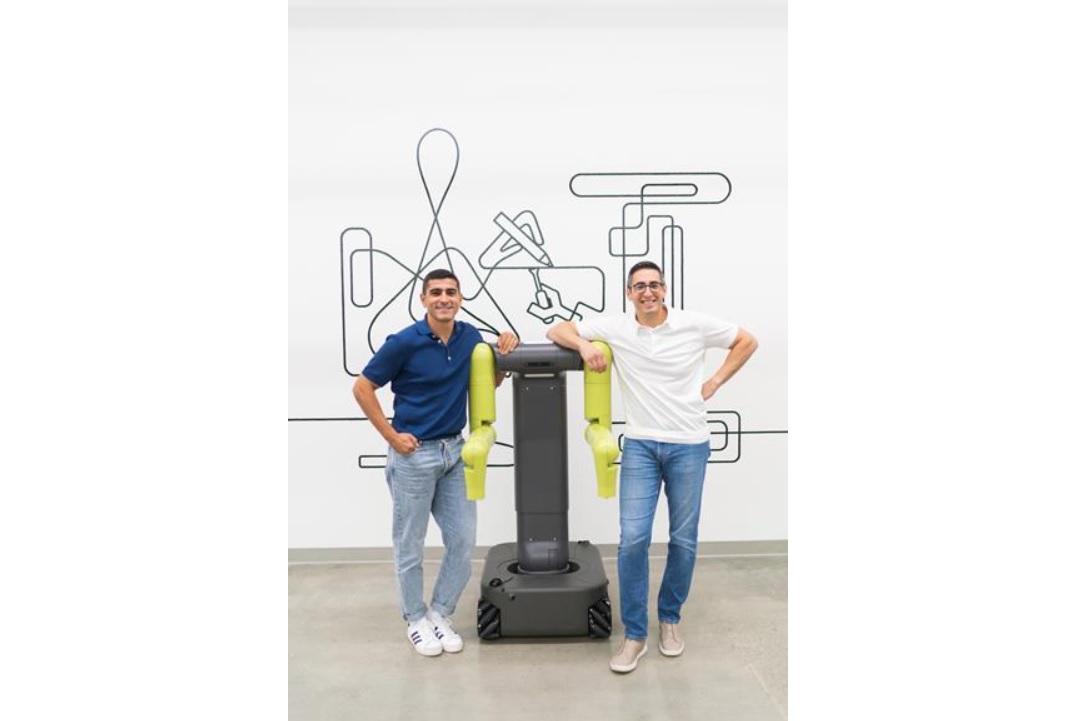
Maven Robotics has raised $100 million in Series A financing to scale an industrial robot platform already being used for mixed-case palletizing and tote handling in warehouse and manufacturing operations.
The Santa Clara, California-based company launched publicly with the financing after operating largely in stealth since its founding in 2024.
RoboStrategy led the round, with LocalGlobe, Vine Ventures and XTX Ventures among the investors.
Maven is pitching a broad vision of general-purpose industrial robotics, but its immediate warehouse proposition is considerably more concrete: robots that can manipulate mixed products and totes in operating logistics environments.
The company says fleets are already running autonomously across multiple shifts each day for an unnamed Fortune 250 consumer packaged goods company.
Independent reporting provides a closer view of that deployment.
TechCrunch reported that as many as eight Maven robots were operating for roughly 16 hours a day, with CEO Hamza Derbas claiming uptime of at least 99%.
Those figures provide evidence of sustained customer operation beyond a short demonstration, although important performance measures remain undisclosed.
Maven has not published cases or pallets handled per hour, intervention frequency, pick accuracy, product-damage rates or the measurement period behind the uptime figure.
The customer and deployment location also remain unidentified.
Maven’s robots are wheeled, dual-arm systems, according to TechCrunch, with mixed-case palletizing forming a central part of their initial commercial work.
That is a demanding warehouse application because the robot is not simply repeating a fixed movement with identical loads.
Mixed-case pallet building requires products with different dimensions and weights to be manipulated into outbound pallet configurations that can vary according to the order or destination.
TechCrunch reported that Maven’s initial deployment involves rebuilding incoming products into store-specific mixed pallets.
Tote handling is the other initial application identified by the company.
Maven says it is already expanding toward more complex material-handling and assembly tasks, part of its attempt to build a robot platform capable of performing multiple categories of industrial work rather than engineering a separate machine around each process.
The $100 million round gives the company substantial capital to test that proposition at greater scale.
Fenwick, which represented Maven in the financing, says the company intends to build 250 third-generation robots and begin designing a fourth-generation platform.
Maven has not disclosed a production schedule for those 250 robots, how many have already been ordered by customers or how many sites will receive them.
The company is also setting aggressive targets for operating experience.
Maven expects its deployed fleet to exceed 100,000 hours of autonomous real-world operation by the end of 2026 and one million hours by the end of 2027.
Those are company projections rather than accumulated operating results.
Reaching them would require a substantial increase in deployed robot hours from the operational footprint described publicly so far.
The company says its technology combines hardware, software and AI across individual robots, fleets and factory-level operations.
Maven describes the resulting system as the world’s first general-purpose robotics platform for industrial work.
That distinction has not been independently established and is better understood as the company’s positioning for a market where multiple robotics developers are attempting to broaden machines beyond narrowly programmed tasks.
For warehouse operators, the more useful question is whether a common robotic platform can reliably perform enough different material-handling functions to justify deployment outside tightly structured automation cells.
Maven’s current palletizing and tote-handling work provides an initial test.
Its longer-term plan is to extend the same platform into more complicated material handling and assembly, although the company has not specified the next warehouse applications or when they will become commercially available.
Cold storage presents another unanswered question.
Mixed-SKU palletizing is not limited to ambient distribution. Automated mixed-load pallet building is also used in frozen-food logistics, where reducing manual work inside low-temperature areas can have operational and workforce benefits.
But workflow relevance does not establish robot suitability.
Maven has not said that its robots operate in refrigerated or frozen warehouses.
No minimum operating temperature, freezer rating, cold-room battery performance or environmental specification has been disclosed. There is also no named chilled or frozen-food deployment.
That distinction is particularly important for a mobile robotic system.
Refrigerated warehouses can operate below freezing, creating equipment requirements involving batteries, sensors, lubrication and transitions between different temperature environments.
There is currently no public evidence showing how Maven’s platform performs under those conditions.
The unnamed CPG customer should not be treated as evidence of cold-chain capability either. Consumer packaged goods encompasses a wide range of products and does not establish that Maven’s existing deployment involves refrigerated inventory.
For now, Maven’s strongest warehouse evidence remains in ambient or otherwise unspecified operating conditions: a small fleet performing mixed-case palletizing and tote-handling work across multiple shifts.
Even there, substantial operating data is still missing.
The company has not disclosed pallet throughput, SKU range, carton dimensions, maximum payload, pallet height, charging strategy, robot pricing, deployment cost or measured return on investment.
Nor has it identified the warehouse management system involved in its existing customer deployment.
Those numbers will matter as Maven moves from an initial customer fleet toward hundreds of robots.
A $100 million financing round gives the company resources to manufacture more machines and develop additional capabilities, but warehouse operators will ultimately judge the platform on sustained production performance rather than its general-purpose label.
The next evidence will come from deployment scale: more named workflows, more customer sites and operating data showing how the robots perform across different products and shifts.
For refrigerated distribution, the threshold is even clearer. Until Maven publishes an environmental specification or identifies a chilled or freezer deployment, cold storage remains a potential application for its palletizing approach rather than a demonstrated capability of the robot itself.