

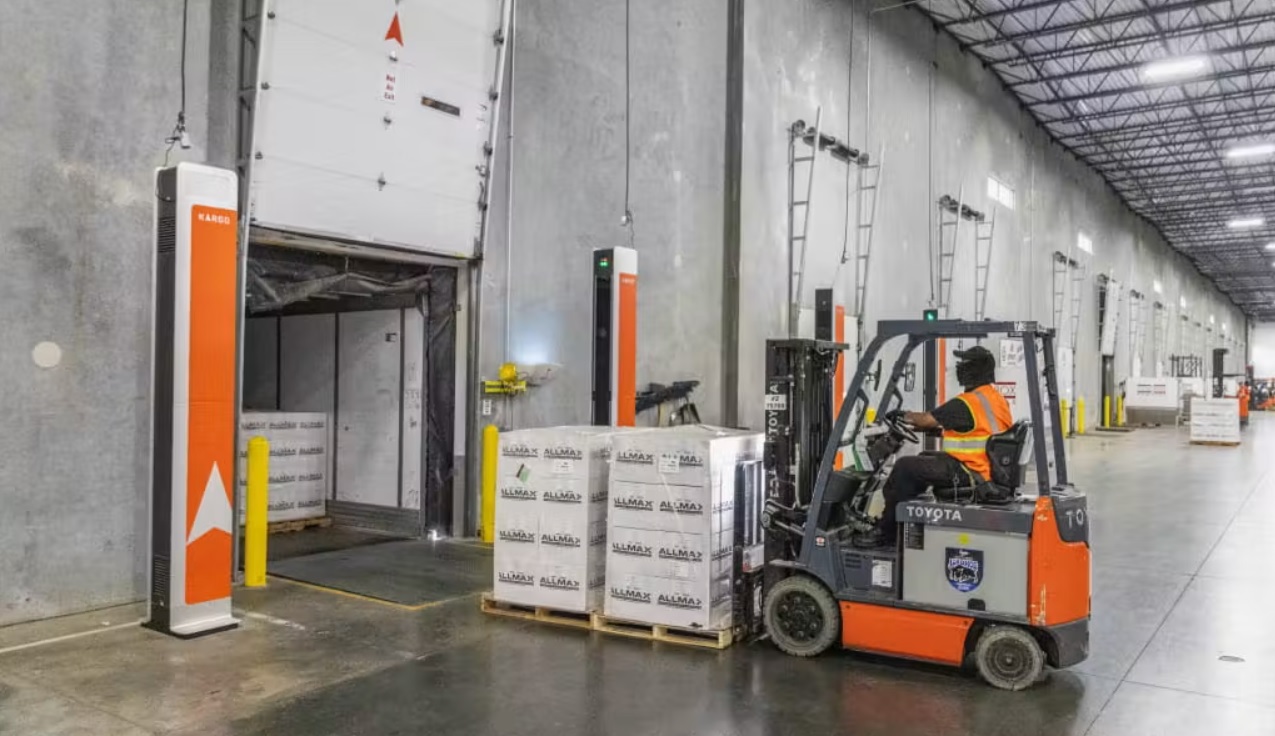
Lineage is using computer vision to automate inventory receiving at a high-volume Alabama cold-storage warehouse, removing manual data-capture steps as poultry products move from adjacent production plants into temperature-controlled storage.
Kargo camera towers installed at Lineage’s Decatur facility automatically capture SKU and lot information from inbound inventory and feed the data into the cold-storage operator’s warehouse management system.
More than 64,000 receipts have been automated during the past six months, according to Kargo and Lineage. The facility handles more than 500 pallets per day.
The two figures are not directly interchangeable. The companies describe 64,000 automated “receipts” while separately providing daily pallet volume, but have not said that each receipt corresponds to an individual pallet.
The distinction between digital and physical automation is also important.
Kargo is not unloading trailers or moving pallets into storage. No robotic unloading, autonomous forklifts, conveyors or automated storage and retrieval systems were disclosed as part of the project.
Instead, the system automates the information layer surrounding inbound pallet movements.
In a conventional process described by the companies, employees scan arriving pallets, reconcile information against bills of lading and enter inventory data into the WMS. At Decatur, fixed camera infrastructure captures relevant information as inventory arrives and passes that data directly into Lineage’s system.
That makes the deployment particularly relevant to a production-linked cold-storage operation, where the physical movement of temperature-sensitive food has to be matched with accurate digital inventory records.
Lineage’s facility directory identifies the site at 110 Plugs Drive in Decatur as a dedicated or leased warehouse handling temperature-sensitive products. The company also lists EDI capability and drop-trailer and container plug-in services at the property.
The warehouse supports adjacent poultry plants, according to the companies. The poultry producer has not been identified.
Lot information is among the data Kargo is capturing automatically at receiving. That is operationally significant in food warehousing, where inventory can require lot-level identification, although neither company has published evidence showing a specific improvement in traceability, recall performance or regulatory compliance from the deployment.
Kargo and Lineage say the automation has reduced receiving tasks that previously required minutes to seconds. They have not disclosed the underlying before-and-after measurements, making it impossible to quantify the time saving independently.
The companies also report improvements in accuracy and throughput and say employees have been reassigned to other activities within the warehouse.
No before-and-after error rates, throughput percentages or labor-hour savings were provided. Lineage has not announced a headcount reduction associated with the technology.
Those missing figures matter when assessing the business case for receiving automation. Kargo and Lineage have not disclosed the investment, number of camera towers installed, proportion of receiving doors covered, software fees or return on investment.
What the Decatur project does provide is evidence of operating scale.
Rather than a laboratory demonstration, the system has been processing receipts for six months in a temperature-controlled facility handling more than 500 pallets daily.
The deployment also follows earlier development work between the two companies.
Kargo disclosed in June 2025 that it had been working with Lineage on computer-vision receiving under a project it called Lineage Eye + Kargo. That work focused on capturing pallet images, extracting label information and reducing reliance on manual inventory entry.
The earlier material identified practical challenges including inconsistent labels, variable image-capture conditions and lot-controlled inventory.
The available sources do not establish that the 2025 pilot itself occurred at Decatur. The earlier project should therefore be viewed as development history for the Kargo-Lineage relationship rather than a confirmed previous phase at the Alabama site.
Kargo’s technology combines dock-door camera hardware with computer-vision software. The company says its broader platform can interpret text, barcodes and QR codes as freight passes through a dock and send captured information to warehouse management systems.
At Decatur, the confirmed functions are narrower: automatic capture of SKU and lot information and integration with Lineage’s WMS. The WMS supplier has not been identified.
The companies are now preparing to extend automation further into the outbound workflow.
Automated load scanning is scheduled to launch at Decatur, although no implementation date or technical details have been disclosed.
That next stage could make Decatur a useful test of how far computer vision can automate the digital records surrounding freight movement without automating the forklifts and other equipment physically handling the product.
For cold-storage operators, that is a different automation proposition from installing cranes, shuttles or robotic pallet handling.
The Decatur project targets a narrower process: ensuring that physical inventory arriving at the warehouse is recognized and entered into the digital inventory system with less manual intervention.
After more than 64,000 automated receipts, Kargo and Lineage have demonstrated that the workflow is operating at commercial volume. The unanswered question is how much measurable operational value it produces.
Error rates, labor hours, receipt-cycle times and throughput improvements remain undisclosed. Those metrics — along with whether Lineage deploys the system at additional cold-storage facilities — will provide a clearer measure of the technology’s impact beyond Decatur.