

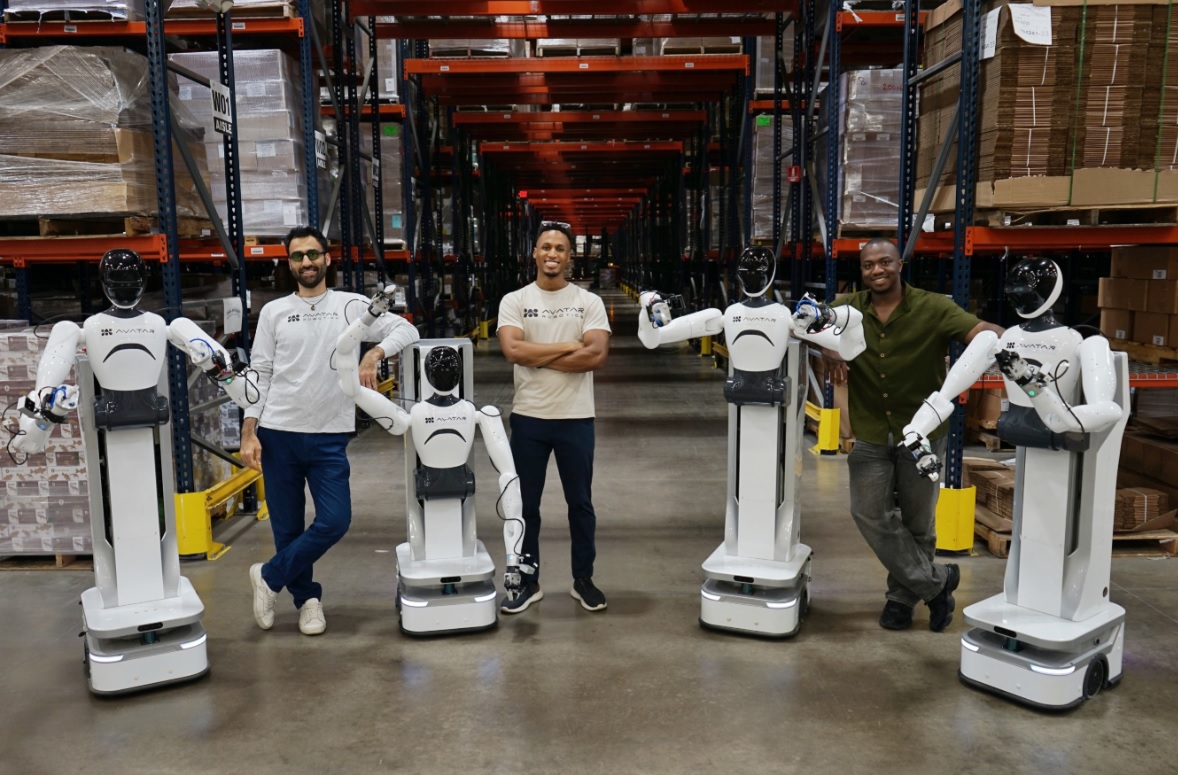
Avatar Robotics has secured $6.5 million in seed funding to expand a warehouse robotics platform that combines humanoid robots, remote human operators and AI, highlighting an alternative approach to industrial automation in which people remain part of the production process while autonomous capabilities continue to develop.
The funding round was led by AlleyCorp, following an earlier pre-seed investment led by defy.vc, with participation from Headline, Henry Ford III, Refashiond, Paul Vogel, Jack Huffard and Samuel Udotong. Avatar said the capital will be used to accelerate customer deployments, expand its robot fleet, develop autonomy software and grow its engineering and operations teams.
Rather than positioning its robots as fully autonomous, Avatar describes its platform as a human-in-the-loop operating model. The company’s humanoid robots perform warehouse activities including picking, packing, sorting, kitting, cycle counting, material movement, rework and assembly, while remote operators intervene when the AI cannot reliably complete a task.
That distinction differentiates the company from developers pursuing fully autonomous warehouse robotics. According to Avatar, teleoperation enables customers to deploy productive robotic labour immediately while the operational data collected during live work is used to improve future autonomous performance.
The company, which launched in December 2025, claims its robots have already helped pack, sort and ship more than 900,000 products in live customer environments. Avatar also says it has progressed beyond pilot testing with a multi-billion-dollar warehouse operator and has supported a leading global beauty retailer. However, it has not identified either customer or disclosed how many robots are deployed, how many facilities are operating or what proportion of the work is completed autonomously.
Those omissions make it difficult to evaluate the platform’s commercial maturity. Avatar has not released productivity data such as units handled per hour, robot utilisation, order accuracy, human intervention frequency, uptime or labour savings, nor has it disclosed pricing or customer return-on-investment figures.
Additional information published by the company indicates the platform is offered as a robots-as-a-service model rather than requiring customers to purchase hardware outright. Avatar says customers pay for productive labour while the robots operate in facilities designed for human workers, reducing the need for extensive warehouse redesign. Those are company claims, and no comparative deployment timelines or cost data have been published.
Independent reporting by Business Insider provides further context on the operating model. The publication reported that remote operators control robots using virtual reality headsets and controllers, with operators located in countries including Mexico, Colombia and the Philippines. Business Insider also reported that Avatar currently sources its robot hardware from China. Neither detail was included in the company’s funding announcement.
The teleoperation model introduces operational considerations beyond robotics performance. Reliable production depends not only on robot capability but also on network connectivity, video quality, operator availability and the transfer of control between AI and remote workers. Avatar has not disclosed network latency, intervention rates, cybersecurity arrangements or safety performance in mixed human-robot warehouse environments.
The funding also comes as warehouse operators continue evaluating automation strategies against changing labour requirements. U.S. Bureau of Labor Statistics data showed approximately 477,000 manufacturing job openings in June 2026, while projecting 3% employment growth in transportation and warehousing between 2024 and 2034. Those figures indicate continuing demand for industrial workers but do not establish a universal labour shortage across all warehouse roles.
Avatar argues that its model can provide immediate labour capacity while generating the operational data needed to increase robot autonomy over time. Founder and chief executive Colin Webb said the company’s objective is to make industrial work more scalable by enabling people to operate robot fleets remotely, while AlleyCorp said the platform is already delivering value in real warehouse workflows. Those statements reflect the views of the company and its investors rather than independently verified operating performance.
The seed funding gives Avatar additional resources to expand deployments at a time when interest in humanoid robotics is increasing across logistics and manufacturing. Whether the company’s hybrid approach proves commercially competitive, however, will depend on operational evidence that remains undisclosed, including fleet size, productivity, autonomy levels, customer economics and long-term safety performance.