

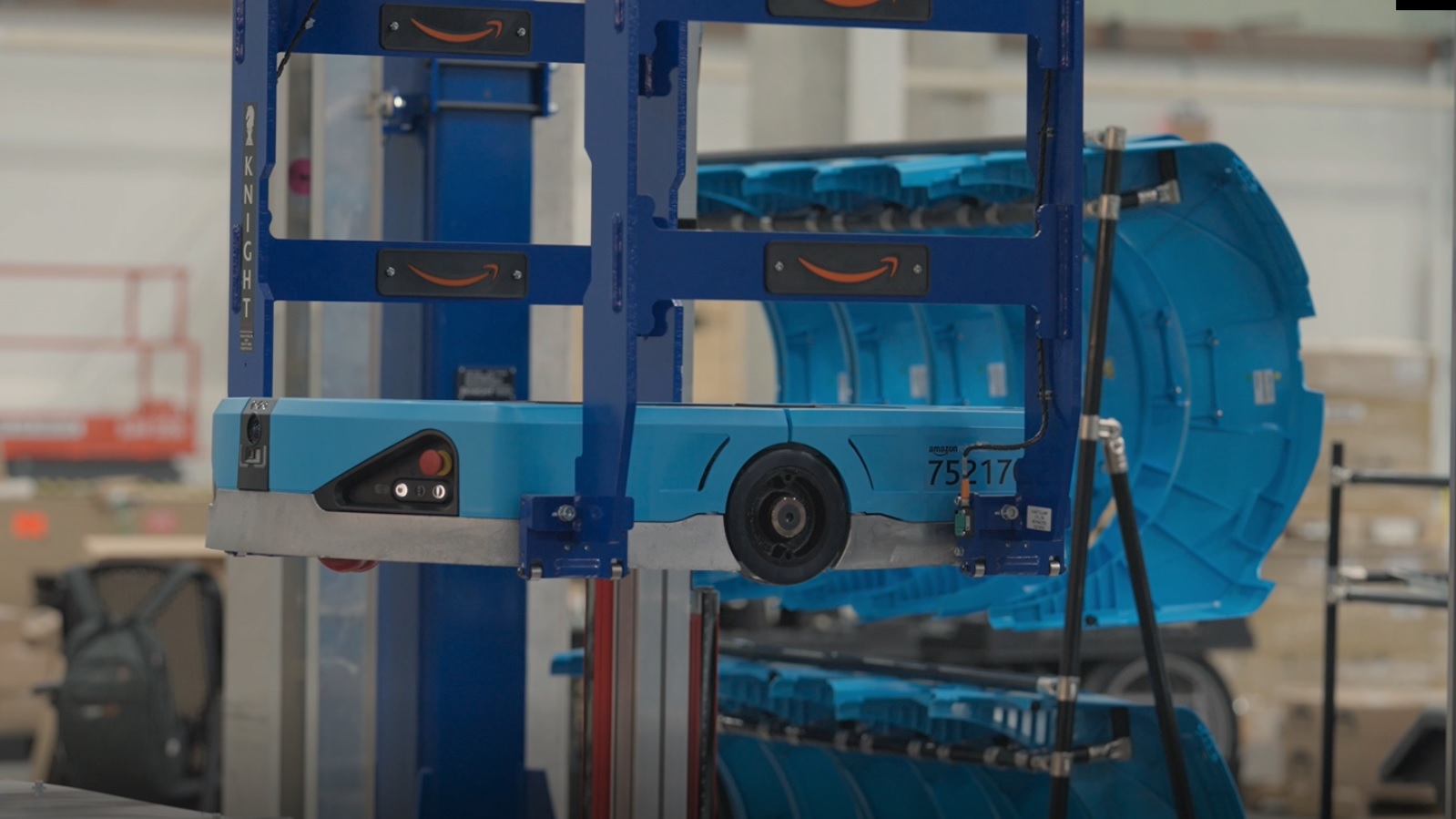
Amazon is planning a multi-billion-dollar robotics manufacturing facility in Austin, extending its warehouse automation strategy upstream into additional US production capacity.
The Texas plant will manufacture robotic systems for Amazon’s own operations and is expected to create between 300 and 500 manufacturing and engineering jobs.
Amazon has not disclosed the factory’s square footage, exact investment, construction timetable or production capacity. Nor has it identified which of its robotic systems will be manufactured in Austin.
Those omissions leave the project’s physical scale unclear despite the multi-billion-dollar investment description. What the announcement does establish is that Amazon is adding another manufacturing base for technology deployed inside its logistics network rather than another fulfillment or distribution center.
Amazon already has a substantial robotics manufacturing operation in Massachusetts.
Its Westborough facility, which opened in 2021, contains approximately 350,000 square feet of manufacturing, research and development and office space. Amazon said that project created more than 200 manufacturing jobs.
Amazon has described its Massachusetts manufacturing operation as capable of producing as many as 1,000 robots per day. Its robotics manufacturing footprint in the state includes facilities in Westborough and North Reading; Amazon has provided no equivalent production target for Austin.
The expansion follows another milestone on the deployment side of Amazon’s automation program. The company said in 2025 that it had deployed its one-millionth robot across its operating network.
Its robotics portfolio now includes systems for functions such as inventory movement, cart transport and item handling. Amazon has not said whether named platforms including Hercules, Proteus or Sparrow will be produced at the Texas plant.
Independent reporting provides more detail about where the factory is expected to be located.
Austin Current/KUT reported in July that Assistant City Manager Eric Johnson identified Amazon’s robotics division as the prospective anchor industrial tenant for Dog’s Head, a large redevelopment in Southeast Austin.
Community Impact subsequently reported that the proposed Amazon project would occupy roughly 300 acres within the development.
Amazon’s August announcement identifies only Austin as the factory location and does not confirm Dog’s Head or disclose an address. The connection therefore rests on the earlier local reporting and statements from city officials.
The wider Dog’s Head development covers approximately 2,645 acres bounded by the Colorado River, US Highway 183 and State Highway 130, according to City of Austin records.
The city has approved actions related to a tax-increment reinvestment zone and infrastructure arrangements for the broader development.
That public financing should be distinguished from the Amazon plant itself.
Austin Mayor Kirk Watson said in Amazon’s announcement that the company requested no economic incentives and no public money for the manufacturing facility. That does not mean the wider Dog’s Head development involves no publicly supported infrastructure financing.
Amazon has put workforce and research capabilities at the center of its explanation for choosing Austin.
The company already employs about 17,000 people in Austin and approximately 86,000 across Texas, according to its own figures. It says it has invested more than $100 billion in the state since 2010.
Austin also gives Amazon an existing university relationship in fields relevant to robotics manufacturing.
The University of Texas at Austin and Amazon established the UT Austin-Amazon Science Hub in 2023, with research spanning robotics, machine learning and related areas. The university independently confirms those research areas, although neither Amazon nor UT has said that work from the hub will feed directly into production at the new factory.
Amazon also plans STEM partnerships with Austin Independent School District and Del Valle Independent School District.
The move into Austin adds manufacturing capacity to a robotics operation that has grown alongside automation across Amazon’s warehouses.
Amazon says robots similar to the systems planned for Austin have contributed to reductions in its recordable- and lost-time-injury rates. Those are company claims, and the announcement does not isolate the effect of robotics from other operational or safety changes.
More consequential for the automation sector will be what Amazon eventually discloses about the factory itself.
There is no information yet on production lines, component sourcing, power requirements, manufacturing automation, suppliers or whether any output will be available outside Amazon’s own network. The company also has not said whether Austin will alter production at its Massachusetts facilities.
That makes it premature to describe Texas as replacing Massachusetts as Amazon’s principal US robotics manufacturing hub.
For now, the project points to expansion rather than relocation: Amazon is committing a multi-billion-dollar investment to manufacturing the machines used in its increasingly automated logistics network while retaining an established robotics production and engineering base in Massachusetts.
The scale of that expansion will become clearer when Amazon identifies the Austin factory’s footprint, product mix, annual production capacity and construction schedule.