

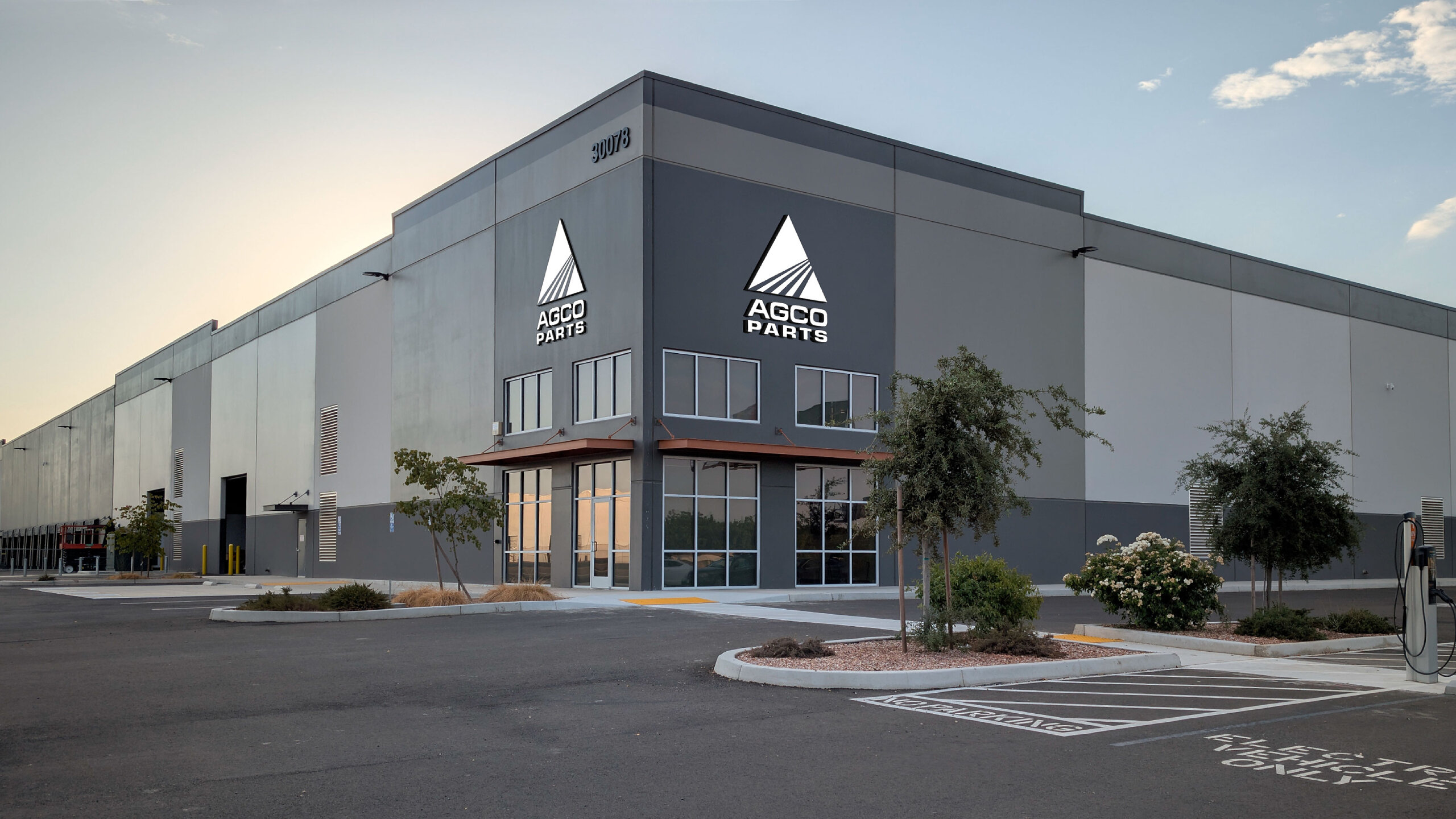
AGCO has opened a 115,000-square-foot parts distribution center in Visalia, California, introducing automated high-density storage as the agricultural equipment manufacturer expands its West Coast parts operation.
The facility begins operations September 1 and replaces AGCO’s existing Visalia warehouse with a distribution center designed around a mix of vertical lift modules, narrow-aisle racking and dedicated storage for oversized machinery components.
That combination reflects a central challenge in agricultural parts logistics: accommodating inventory with markedly different storage profiles within the same distribution operation.
AGCO has not disclosed its SKU count or the products assigned to each storage system, but the new layout provides separate approaches for dense parts storage and larger components that require more conventional handling space.
Vertical lift modules provide the most clearly identified automation in the building. The systems store inventory vertically on trays and automatically present requested items at an access point, reducing the floor area needed for suitable parts compared with conventional shelving.
AGCO has not named the VLM supplier, disclosed how many modules have been installed or provided their tray count, storage capacity or picking throughput.
The remainder of the warehouse includes high-density narrow-aisle racking and specialized material-handling equipment. AGCO has not said that movement within the narrow aisles is automated, so the system should not be considered an automated storage and retrieval system based on the information released.
The physical changes form part of a wider redesign of AGCO’s parts operation from receiving through shipping.
The company says improved forecasting and deeper local inventory will be used alongside the warehouse systems to increase parts availability for dealers and farmers across the western United States.
No measured improvement in fill rates, order cycle times, picking productivity or delivery lead times has been disclosed.
AGCO first announced the replacement warehouse in August 2025, describing it as a multimillion-dollar investment. The company has still not released an exact project cost.
Independent local reporting identifies the new facility at 30041 Bradham Drive, less than three miles from the warehouse it replaces at 9860 W. Ferguson Ave.
The move continues a Visalia distribution presence that began when AGCO relocated its parts operation from Stockton in 2016.
At 115,000 square feet, the new building more than doubles the size of AGCO’s West Coast operation, according to the company. AGCO separately says the facility provides expanded stocking capacity, allowing it to hold a broader range of parts closer to western U.S. dealers and agricultural customers.
The company has not disclosed the exact increase in SKU positions or physical inventory capacity.
Staffing provides another notable dimension to the expansion.
The Business Journal reported when the project was announced that approximately 20 people were expected to work at the new warehouse, roughly the same staffing level as the existing operation.
The larger footprint and automation therefore are not accompanied by an announced increase in warehouse headcount. There is no evidence, however, that automation reduced labor requirements, and AGCO has not published productivity figures that would support such a conclusion.
Operationally, the facility serves AGCO’s full brand portfolio, including Fendt and Massey Ferguson, and is intended to hold more parts closer to western U.S. dealers and agricultural customers.
That regional inventory strategy can be particularly important for replacement parts because equipment downtime can make availability and delivery speed more consequential than in conventional replenishment distribution.
A Quinn Company executive said the increased local inventory could allow the AGCO dealer to get required parts to farmers on the same day. That is an anticipated dealer benefit rather than a network-wide service commitment or independently measured result.
AGCO also designed the building to support expected ecommerce growth for more than 20 years.
The company says the project followed four years of network analysis, design and collaboration, indicating that the replacement was planned as a long-term reconfiguration of its western parts network rather than simply an increase in warehouse square footage.
Digital infrastructure and improved forecasting form part of that design, although AGCO has not identified the warehouse management, warehouse execution or forecasting software used at the site.
The building also incorporates rooftop solar and electric-vehicle charging stations. Solar generation capacity and the proportion of warehouse electricity expected to be supplied by the system have not been disclosed.
Visalia is not AGCO’s only major parts-distribution investment.
The manufacturer is also developing a much larger 95,000-square-meter parts distribution center in Amnéville, France, designed to consolidate five nearby operations. AGCO has said the French facility will process more than five million order lines annually and use advanced automation.
The two projects differ substantially in scale and function, and AGCO has not said they use the same automation systems. Together, however, they show the company investing in new physical infrastructure for both regional and wider parts distribution.
At Visalia, the most tangible change is the way inventory will be stored and handled.
AGCO has moved beyond simply adding warehouse space by combining automated vertical storage, dense racking and separate handling for oversized components within a larger replacement facility.
What remains missing are the operational measurements needed to judge the result.
AGCO has not disclosed SKU capacity, daily shipments, order-line throughput, picking rates or before-and-after service levels. It has also kept the automation and material-handling suppliers private.
Those figures will determine how much performance the redesigned warehouse extracts from its larger footprint. For now, Visalia provides a clear example of automation being applied to the mixed inventory requirements of agricultural aftermarket parts distribution — without the company claiming that every part of the warehouse has been automated.