

Maersk says it has begun managing PUMA’s North American distribution network under an expanded agreement covering three automated U.S. warehouses totaling approximately 2.3 million square feet.
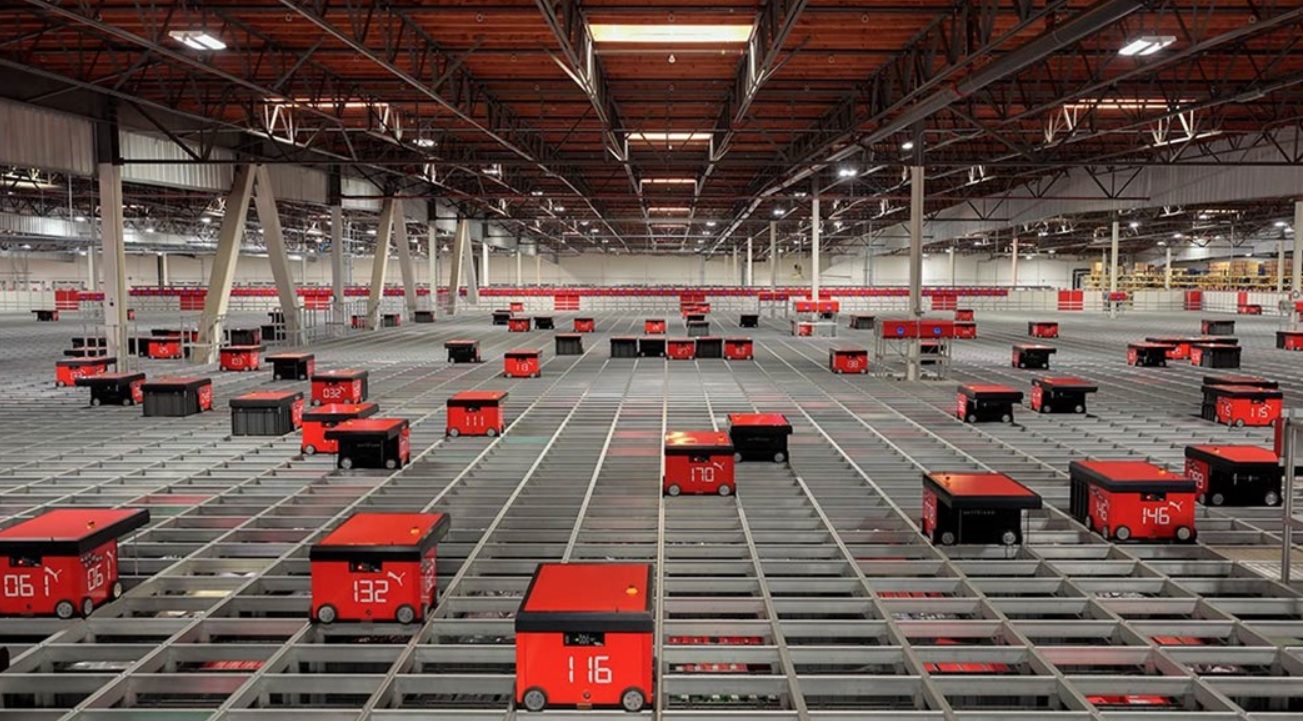
The facilities are in Torrance, California; Phoenix, Arizona; and Whitestown, Indiana. They support PUMA’s wholesale customers, retail stores and online shoppers, and all three are equipped with AutoStore robotic storage and retrieval systems.
The announcement establishes that Maersk has begun managing the network. It does not specify whether the operating handover has been completed at each individual warehouse or provide a site-by-site transition schedule.
The agreement changes responsibility for an existing distribution network rather than adding new warehouse buildings or announcing a new automation installation.
The next planned change is at Torrance, where Maersk intends to make capacity available to brands beyond PUMA beginning in 2027. The company describes the proposed operation as its first North American AutoStore deployment supporting multiple clients.
The 672,000-square-foot Torrance facility has a stated capability of handling approximately 20 million units annually, according to Maersk. That figure is a capacity claim, not a disclosure of actual annual throughput or the volume available to additional customers.
Maersk has not identified the brands expected to use the shared operation or explained how capacity will be divided between them and PUMA.
The other two warehouses account for most of the network’s floor area. Phoenix covers approximately 1.02 million square feet, while Whitestown, in the Indianapolis area, totals approximately 636,000 square feet.
The companies have not disclosed how wholesale, store-replenishment and e-commerce volumes are distributed among the three locations.
AutoStore is the named automation platform across the network. Its robots retrieve inventory bins from compact storage grids and deliver them to employee workstations for picking and packing.
Maersk says the technology can reduce employee travel and manual handling while improving space utilization and fulfillment productivity. The announcement does not provide measured before-and-after results for the PUMA facilities under Maersk’s management.
At Torrance, the proposed multi-client model would introduce additional inventory and order flows into an existing automated operation. How Maersk will allocate storage, picking capacity and service commitments among customers has not been disclosed.
Nor has the company announced whether the change will require additional robots, workstations, software or other equipment.
The expanded agreement builds on a logistics relationship that already spans ocean and air freight, customs services, inland transportation, warehousing and fulfillment.
Maersk says its objective is to combine its operating capabilities and wider logistics network with PUMA’s existing automated infrastructure. PUMA expects the arrangement to improve product movement and responsiveness to demand.
Those benefits remain company expectations. Neither party has disclosed realized cost savings, productivity gains or delivery-performance improvements arising from the expanded agreement.
Financial terms and contract duration have not been announced. The companies have also not identified the previous operating arrangements at each site or disclosed current staffing and throughput.
Maersk says its North American fulfillment network includes more than 70 facilities covering approximately 22.5 million square feet. The PUMA agreement gives it a substantial role in an established automated distribution network, although the announcement does not establish that Maersk has acquired the underlying properties.
Torrance will be the next site to watch. Its planned transition to multi-client fulfillment will test how Maersk allocates existing automated capacity among brands while continuing to meet PUMA’s distribution requirements. The timing of full operating handover at each of the three warehouses remains undisclosed.