

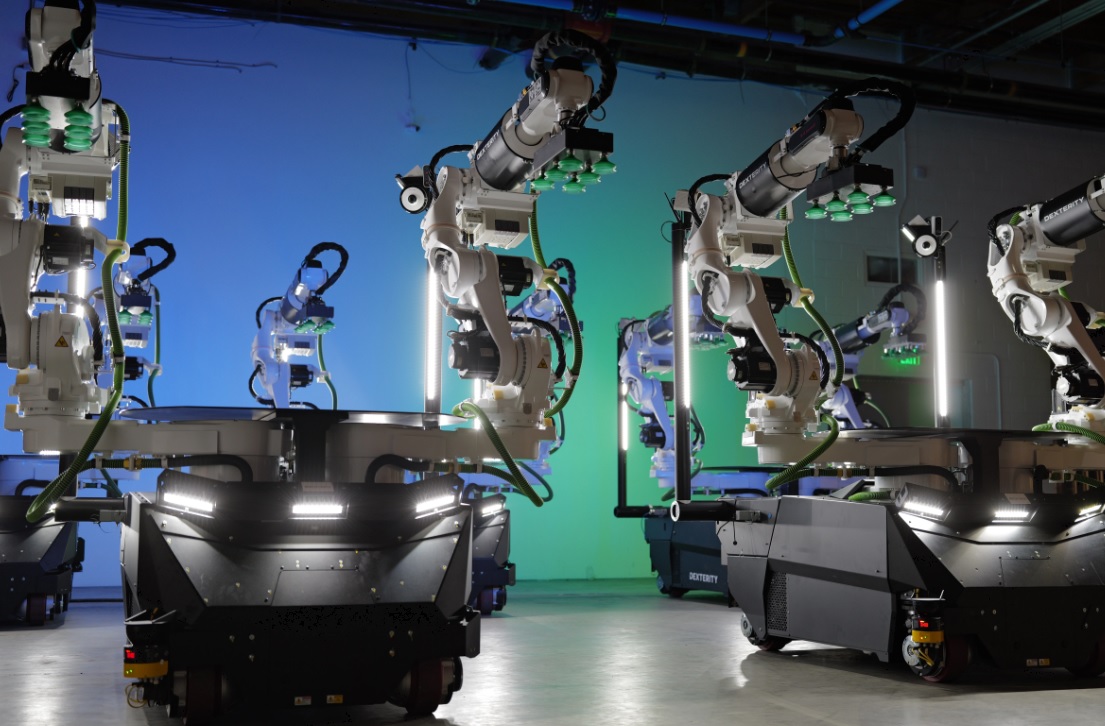
Kawasaki Robotics and Dexterity are moving a jointly developed eight-axis robot arm into production as Dexterity scales its Mech platform for one of warehouse automation’s more difficult physical tasks: handling variable cartons inside trailers.
The RL030N is being integrated into Dexterity’s mobile, dual-arm Mech robots for applications including trailer loading and unloading.
Its production marks a progression from a development partnership announced by Kawasaki and Dexterity in 2025, when the companies began working on robot arms specifically designed around Mech and warehouse handling requirements.
The resulting RL030N adds an eighth degree of freedom to the manipulator.
That additional articulation is intended to give the robot greater freedom of movement when reaching and handling packages in confined environments where the geometry of the workspace and load continually changes.
That makes the engineering relevant to a specific logistics problem rather than simply adding another industrial robot to a warehouse.
Inside a trailer, cartons can vary in size, weight, shape, orientation and condition. Loads change as packages are added or removed, while cartons can shift, deform or fall during handling.
Those conditions make trailer work less predictable than many fixed industrial automation processes built around repeatable products and predetermined movement paths.
Kawasaki and Dexterity designed the RL030N around that variability.
The arm forms one part of a broader technology stack rather than operating as a standalone robot.
Dexterity’s Mech platform provides the mobile base and dual-arm configuration, while its Foresight World Model and production software handle perception, planning and manipulation.
Kawasaki’s KRNX real-time control API provides the interface to the arm.
Kawasaki says KRNX allows external AI software, ROS environments and third-party orchestration systems to interact with its robot technology in real time.
That separation between industrial hardware and higher-level AI control is central to the collaboration.
Kawasaki contributes the manipulator, control technology and manufacturing expertise, while Dexterity applies its AI and mobile robot architecture to determine how the arms interact with packages and the surrounding logistics environment.
The companies say requirements from Dexterity’s Mech program influenced development of the RL030N before Kawasaki Robotics and Kawasaki Heavy Industries translated those requirements into a production-ready platform.
Dexterity is now expanding Mech production and scaling deployments using the arm.
Neither company has disclosed how many RL030N-equipped Mechs are being manufactured, how many have been ordered or how many customer sites will receive the production version.
The companies also say the RL030N has demonstrated strong reliability in real logistics environments, but they have not published uptime, mean time between failures or intervention data supporting that claim.
Customer-side evidence does show that the broader Mech platform has advanced beyond demonstrations.
FedEx said in July that it was expanding deployment of Dexterity’s Mech and Foresight trailer-loading technology at its Hagerstown Hub in Maryland after multiple years of development, testing and operational validation.
The expansion moves Dexterity’s trailer-loading technology beyond its earlier pilot environment toward a larger production deployment.
It should not, however, be treated as confirmation that the Hagerstown robots use the newly named RL030N arm.
Neither FedEx nor the available Kawasaki and Dexterity disclosures explicitly make that hardware connection.
The distinction matters because FedEx provides evidence for the commercial maturity of the broader trailer-loading application, not independent validation of every performance claim attached to the RL030N.
The companies have not published RL030N-specific throughput in cartons per hour, trailer loading or unloading times, intervention frequency, loading density, operating cost or payback.
Those measures will be important in determining whether the additional mechanical flexibility and AI control translate into operational gains at scale.
Dexterity does publish physical specifications for the wider Mech platform.
The company says each arm can lift as much as 65 pounds, giving the dual-arm robot a combined lifting capability of up to 130 pounds, and that Mech can place cartons as high as eight feet.
Those are manufacturer specifications rather than independently measured performance across warehouse deployments.
Environmental limits also put a useful boundary around potential applications.
Dexterity currently specifies Mech for operation from 0°C to 50°C, or 32°F to 122°F.
The lower limit could place the platform within the temperature range of some above-freezing refrigerated logistics operations, depending on the facility and application.
It does not establish freezer capability.
There is no disclosed Mech/RL030N deployment in a refrigerated or frozen warehouse, and the published operating range provides no support for subzero use.
Dexterity has also not disclosed low-temperature battery performance, condensation controls, freezer-rated components or operation during repeated transitions between cold and ambient environments.
The 0°C specification therefore should not be interpreted as cold-storage certification.
For conventional warehouse and parcel operations, the more immediate commercial test is trailer handling.
FedEx’s Hagerstown expansion gives Dexterity a named production environment for autonomous loading, while the Kawasaki collaboration supplies a robot arm designed around the reach and articulation requirements of the task.
Dexterity has also disclosed operational validation of Mech with Sagawa Express at its X Frontier relay center in Tokyo, adding another logistics setting in which the platform has been evaluated for truck loading.
Those deployments indicate where the technology is being directed, but they do not yet provide a common set of independently verified performance measures.
Trailer automation has repeatedly posed a difficult robotics problem because the robot cannot rely on a perfectly structured environment.
The machine has to work within a confined trailer while adapting its movements to packages and load patterns that change continuously.
The RL030N gives Dexterity a production industrial manipulator designed around those conditions.
What remains to be established is the scale at which that combination can operate.
Deployment counts, sustained throughput, uptime and intervention rates will provide a clearer measure of whether the production-ready arm and Dexterity’s Physical AI stack can turn trailer loading and unloading into a repeatable warehouse automation application rather than a collection of site-specific deployments.