

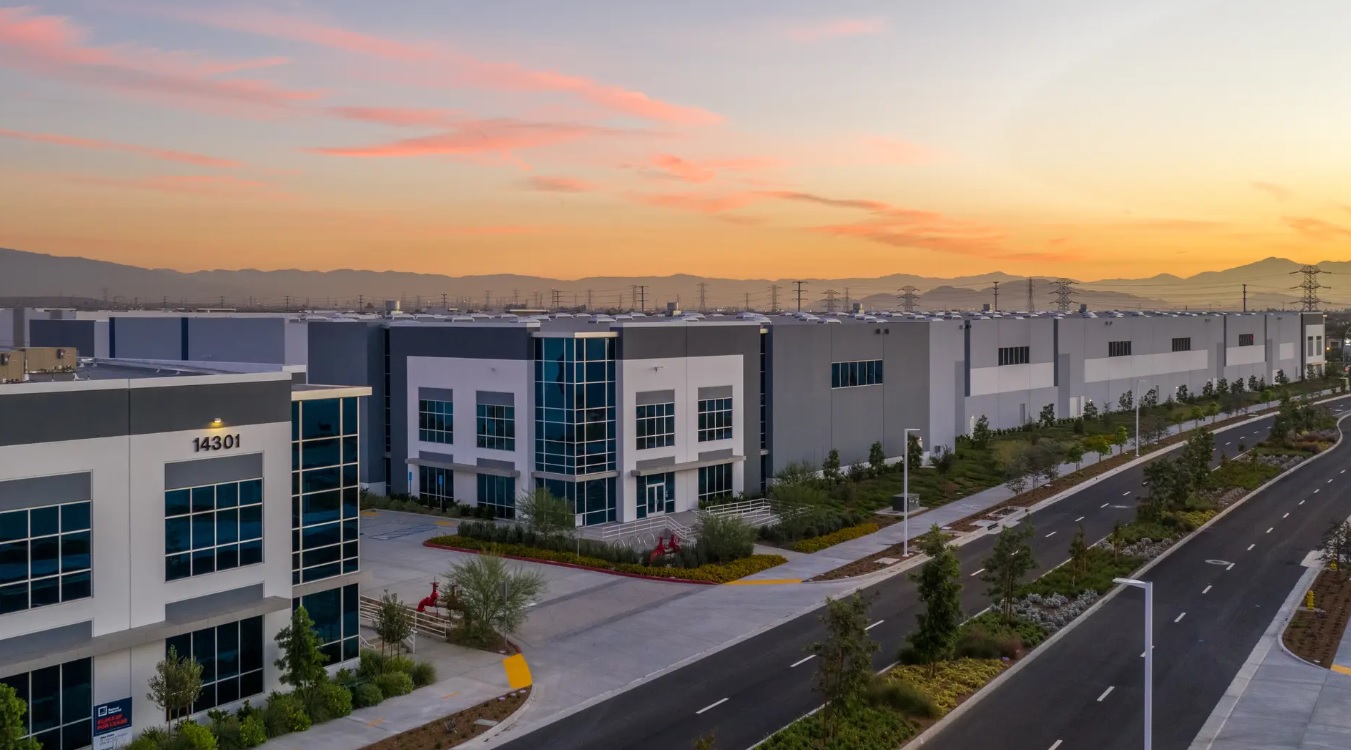
EQT Real Estate has acquired 5.2 million square feet of Southern California logistics property from Rexford Industrial Realty for approximately $1.2 billion, taking ownership of a large occupied warehouse portfolio spanning coastal infill markets and Inland Empire freight corridors.
The transaction comprises 22 industrial properties containing 32 buildings, according to Rexford, clarifying a distinction not included in EQT’s announcement, which identifies the building count but not the number of properties.
Rexford’s regulatory filing says the sale to an EQT affiliate closed September 16.
The portfolio is 96% leased to 36 tenants and has a weighted average remaining lease term of 2.7 years.
Those figures make the acquisition an immediate expansion of EQT’s Southern California logistics real-estate holdings, but not an addition of 5.2 million square feet of new warehouse supply. The buildings already exist and are substantially occupied.
Their geography is central to the transaction.
The assets span Los Angeles, Orange County, the San Gabriel Valley, South Bay and Inland Empire West.
More than half of the portfolio’s square footage is in the first four infill markets, where EQT says the properties are within approximately 25 miles of the Los Angeles and Long Beach port complex.
Another 46% is concentrated in Inland Empire West.
Those properties have access to the I-10, I-15, SR-60 and SR-91 corridors as well as Ontario International Airport, positioning that portion of the portfolio within one of Southern California’s principal inland distribution areas.
The combination gives EQT exposure to different logistics geographies rather than a single warehouse format.
EQT describes the coastal properties as serving supply-constrained infill markets and distinguishes their role from larger regional distribution facilities in the Inland Empire.
Property-level information is not sufficient, however, to classify individual buildings as last-mile, regional distribution or other warehouse types.
The tenant base is similarly varied.
EQT identifies occupants across logistics and third-party logistics, automotive, apparel and fashion, consumer electronics, food and beverage, consumer goods, chemicals and plastics, aerospace and defense, and electrical, HVAC and building products.
Individual tenants have not been disclosed.
The presence of food-and-beverage users also does not establish that any of the properties contain refrigerated or frozen warehouse capacity.
Rexford says the portfolio averages approximately 237,000 square feet per property.
Beyond that average, neither side has published a complete property schedule detailing the size and operational specifications of all 32 buildings.
The seller’s disclosures also add an important counterpoint to EQT’s investment rationale.
EQT emphasizes port-driven logistics demand, constrained development and the opportunity to work with tenants as leases roll over.
Rexford, meanwhile, says in-place rents across the portfolio were 28% above current market rents at closing.
The seller expects those above-market leases to create rent roll-down as contracts reset and has also anticipated tenant move-outs.
Rexford says those assumptions are incorporated into its estimated 5.5% cash net operating income yield for the portfolio in 2027.
That creates a more complicated near-term leasing picture than occupancy alone suggests.
The properties enter EQT ownership at 96% leased, but the relatively short 2.7-year weighted average remaining lease term means a portion of that income will be exposed to lease decisions and prevailing market rents over the next several years.
EQT sees opportunity in that turnover.
Gardner Ellner, managing director for US logistics investments at EQT Real Estate, said the diversified tenant base provides opportunities for the firm to deepen relationships as leases roll over.
Rexford’s sale is part of a different portfolio strategy.
The Southern California-focused industrial REIT has identified the transaction as part of a $2 billion non-core portfolio realignment.
Following the EQT sale, Rexford said its completed dispositions for 2026 had reached approximately $1.5 billion.
Its SEC filing says net proceeds are intended for general corporate purposes that can include debt repayment, common-stock repurchases and internal repositioning and development projects.
The result is a transaction serving different objectives on each side.
EQT is acquiring a large, substantially occupied logistics portfolio across five Southern California submarkets, while Rexford is using the sale to advance a broader program of asset recycling and balance-sheet management.
For EQT, the acquisition also adds scale without the lead time associated with developing new industrial buildings.
The buyer says more than half of the portfolio is positioned in coastal infill markets with limited inventory growth, while the Inland Empire component provides access to the region’s principal highway infrastructure and Ontario International Airport.
EQT also points to the San Pedro Bay port complex as a major driver of logistics demand, stating that the ports account for approximately 31% of US containerized international waterborne trade.
That figure is presented by EQT as part of its investment thesis, as are its assertions that constrained supply and port-related demand will support long-term portfolio performance.
The acquisition does not include a disclosed warehouse modernization program.
There is no portfolio-wide plan for AS/RS, robotics, automated sortation, AMRs or other material-handling technology in the available transaction information.
EQT has also not announced redevelopment, warehouse expansion or major capital expenditure associated with the purchase.
Building-level specifications remain another significant information gap.
Clear heights, dock-door counts, trailer parking, yard configurations, pallet capacities and building ages have not been provided across the full portfolio.
There is also no complete public breakdown of tenant square footage, individual lease expirations or the allocation of the $1.2 billion purchase price among the 22 properties.
Those details will determine the warehouse-level character of EQT’s new holdings more precisely.
At portfolio level, however, the transaction is substantial: $1.2 billion changes ownership of 5.2 million square feet of existing Southern California industrial space across 22 properties and 32 buildings.
The next phase will be driven less by adding physical warehouse capacity than by how EQT manages the existing buildings and their leases as a 96%-occupied portfolio moves through a relatively short lease-rollover cycle.