

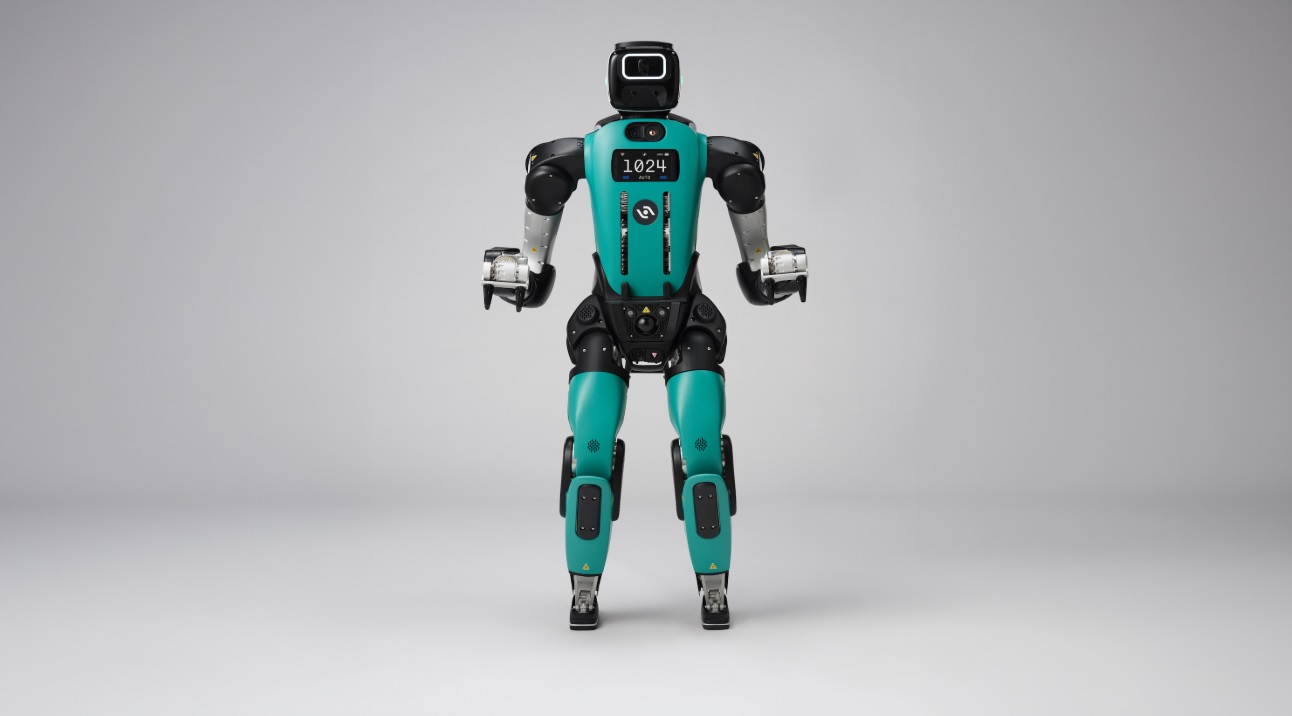
Agility Robotics has unveiled the fifth generation of its Digit humanoid robot, introducing new hardware designed for broader industrial deployment after earlier versions moved from trials into commercial warehouse material handling.
Digit 5 arrives with a warehouse operating history that makes the launch more than another humanoid robotics demonstration.
GXO Logistics already uses Digit in a commercial logistics workflow at a SPANX facility in Georgia, where the robot transfers totes from autonomous mobile robots to conveyor equipment.
That application provides a useful indication of where Agility sees humanoids fitting into warehouses.
Rather than replacing the surrounding automation, Digit operates as one component within it, physically connecting an AMR-based movement process with fixed conveyor infrastructure.
Agility says Digit 5 incorporates changes to safety, durability, reliability, perception, computing and battery architecture based partly on experience accumulated through earlier commercial deployments.
The company has also redesigned elements of the robot to simplify servicing and manufacturing as it attempts to increase deployment volumes.
Material handling remains a primary application.
Digit’s bipedal, human-scale form allows it to move through facilities and interact with equipment designed around human workers, while its arms provide the manipulation capability needed for physical handling tasks.
The commercial question is whether that flexibility can be converted into reliable and economically competitive warehouse work at greater scale.
GXO provides Agility’s strongest disclosed operating evidence so far.
The logistics company signed a multi-year agreement with Agility in 2024 following a proof-of-concept program and confirmed that Digit was being integrated with existing automation at the SPANX operation.
In the documented workflow, an AMR delivers totes to Digit. The humanoid takes the containers and places them onto conveyor equipment.
Agility subsequently said in November 2025 that Digit had moved more than 100,000 totes in the GXO operation.
That milestone is company-reported rather than independently audited, and neither Agility nor GXO has disclosed enough operating data to establish the economics of the deployment.
Totes handled per hour, uptime, intervention frequency, charging requirements, cost per move and payback period remain undisclosed.
There is also no published comparison showing the operating cost of the Digit workflow against alternative approaches using fixed automation, conventional robotics or manual handling.
Still, the accumulated tote movement distinguishes Digit’s development path from humanoid programs that have yet to progress beyond demonstrations.
Amazon has provided a separate warehouse test environment.
In 2023, the company said it was testing Digit for tote recycling, with the robot collecting and moving empty totes after inventory had been removed.
Both examples point toward a similar initial strategy: applying a humanoid robot to repetitive physical movement within infrastructure that already exists for people and other automation.
Digit 5 is intended to take that approach further.
Agility places particular emphasis on what it calls “cooperative safety,” reflecting the requirement for robots to operate in environments shared with employees and other equipment.
That is especially relevant in warehouses where a humanoid could encounter conveyors, AMRs, forklifts and workers within the same operating area.
The term itself should not be treated as proof of a particular safety certification or independently measured safety performance.
Agility’s announcement describes design improvements intended to support safer shared operation, but the evidence required to evaluate those changes will come from specific certifications, standards compliance and deployment performance.
Manufacturing is another part of the scale-up effort.
Agility has developed its RoboFab manufacturing facility in Salem, Oregon, for Digit production and has said the plant is designed eventually to support output of more than 10,000 robots annually.
That figure represents planned manufacturing capacity, not current production volume.
The company has not disclosed how many Digit 5 units it expects to manufacture this year, how many customers have ordered the new generation or whether existing commercial deployments will transition to Digit 5.
Pricing is also undisclosed.
For warehouse operators, those gaps leave several questions between a successful material-handling application and large fleet deployment.
Agility has not published sustained totes-per-hour performance for Digit 5, continuous operating time, charging duration, mean time between failures or intervention rates.
Nor has it disclosed warehouse-management, execution or control-system integration requirements for the new generation.
Cold storage presents an additional boundary to the current evidence.
Refrigerated warehouses are an intuitively relevant environment for physical automation because they combine repetitive material handling with working conditions that can expose employees to prolonged cold.
But there is no evidence that Digit 5 is designed or qualified for those conditions.
Agility’s September announcement does not disclose a minimum operating temperature for Digit 5, a refrigerated-warehouse rating or a subzero specification.
No commercial Digit deployment in a chilled or frozen warehouse has been identified.
That means Digit’s demonstrated warehouse experience at GXO and its earlier testing with Amazon cannot be extended to cold storage.
Freezer environments introduce environmental and component-performance requirements involving factors such as battery performance, sensing, lubrication and condensation when equipment transitions between temperature zones.
Those are operating considerations, not evidence of deficiencies in Digit 5.
A published environmental specification would be required to determine whether the new platform addresses them.
For conventional warehouse operations, Digit 5 faces a different test.
Agility has already shown that its humanoid architecture can be inserted into a real material-handling sequence involving totes, mobile robots and conveyors.
The fifth generation now has to demonstrate that improvements made from that experience translate into greater reliability, maintainability and deployment scale.
The key evidence will come from production operations: larger fleets, additional warehouse tasks and performance data showing how frequently the robots require intervention and what they cost to operate over sustained shifts.
For cold storage, the threshold is more basic.
Before Digit 5 can be evaluated as a freezer automation option, Agility will need to establish the environmental operating range in which the robot can actually work.