

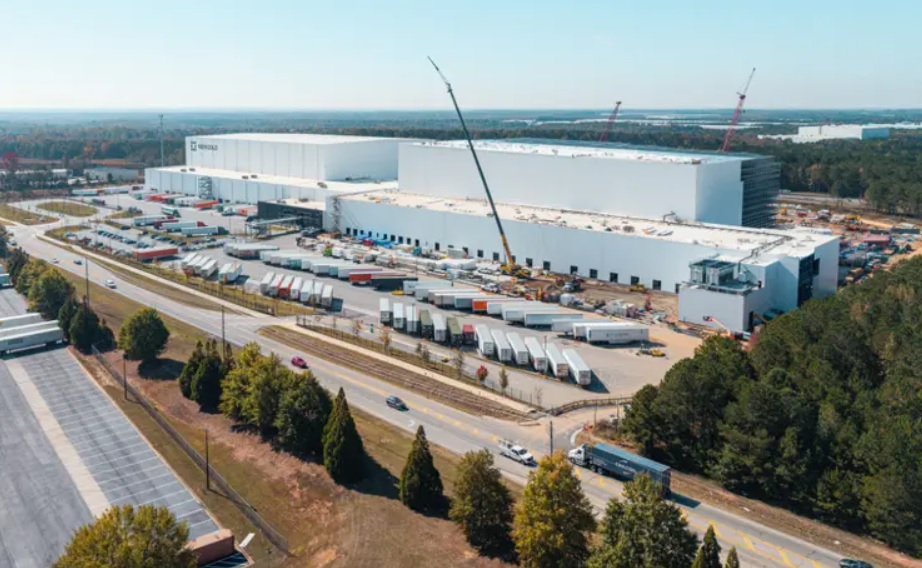
NewCold has expanded its McDonough, Georgia logistics campus with 125,000 frozen pallet positions, turning an operation originally developed for ambient food distribution into a combined ambient and frozen automation site.
The addition brings disclosed storage capacity at the campus to 210,000 pallet positions, based on NewCold’s separate figures of 85,000 ambient and 125,000 frozen positions.
That total represents WarehouseArc’s calculation from the two capacities rather than a figure directly reported by the company.
The frozen warehouse marks the latest stage in the development of a site approximately 30 miles southeast of Atlanta that began operations in 2024.
NewCold’s original McDonough facility was its first dry-goods ambient warehouse in North America.
The company developed that operation as an automated high-bay facility providing 85,000 pallet positions. NewCold identifies the building as 42 meters, or approximately 139 feet, high and equipped with seven automated stacker cranes.
The original project was developed in partnership with Conagra Brands to support the food manufacturer’s dry-goods distribution network in the Southeast.
The relationship should not be extended to the frozen expansion. NewCold has not identified the customers using the new frozen operation or said that Conagra occupies that capacity.
The latest addition materially changes the site’s operating profile.
NewCold announced the 125,000-position frozen warehouse in February and said at the time that it expected the expansion to become operational during summer 2026.
Its September site update now describes McDonough as having expanded with the fully automated frozen facility, establishing the campus as a combined ambient and frozen operation rather than presenting the cold-storage project as future capacity.
The frozen expansion incorporates automated layer picking, according to NewCold.
Across the wider McDonough operation, the company also identifies automated case picking and stacker-crane technology.
NewCold’s current North American facilities overview lists seven double stacker cranes at McDonough, along with automated case picking, a rail dock and a fully integrated drop yard.
The available information does not establish how the seven-crane figure is distributed between the ambient and frozen operations, so it should not be interpreted as a specific crane count for the new freezer building.
NewCold has also not identified the manufacturers of the stacker cranes, case-picking or layer-picking equipment.
The physical configuration nevertheless shows how the company is approaching storage density and downstream handling at the Georgia site.
The original 139-foot ambient high-bay concentrates 85,000 pallet positions vertically, while automated stacker cranes handle storage and retrieval. Case and layer-picking systems extend automation beyond pallet storage into order-building processes.
The frozen addition applies that broader automation model to another temperature regime.
NewCold describes the new freezer as using its proprietary automation technology, but that does not establish that the company manufactures every hardware component in the system.
Suppliers for the refrigeration system, cranes, conveyors, pallet-handling equipment and picking technology have not been disclosed.
The site’s transport infrastructure is also part of the expansion strategy.
McDonough has direct rail capability, with NewCold identifying a rail dock in its current facility information. The company previously said the frozen expansion would also include additional trailer parking and drop-lot capacity.
The campus operates around the clock.
That combination of automated storage, downstream picking and road and rail infrastructure makes McDonough more than a static cold-storage expansion. The site connects high-density inventory storage with order handling and transport functions within the same campus.
NewCold says the location can reach approximately 80% of the U.S. market within two days by road.
That remains a company-stated service-area claim rather than measured delivery performance.
The company similarly says its automation improves efficiency, accuracy and resilience while reducing manual handling and resource consumption.
No McDonough-specific throughput, accuracy or labor comparison has been published to quantify those claims.
The same limitation applies to energy performance.
NewCold identifies high-density storage, energy-efficient technology and optimized material flows at the campus, which operates under ISO 14001-certified environmental management practices.
But the company has not disclosed energy consumption per pallet or quantified savings attributable to the site’s automation and storage design.
Employment has grown alongside the physical operation.
NewCold says McDonough has created more than 200 jobs since opening in 2024, with additional positions being added as part of the frozen expansion.
The company also works with local educational institutions on skills related to logistics, automation, robotics and mechatronics.
The current campus represents a substantial progression from the original project announced several years ago.
NewCold disclosed a $333 million investment in McDonough in 2022 before opening the ambient warehouse in 2024. That investment figure relates to the original development and should not be treated as the cost of the 2026 frozen expansion.
NewCold has not disclosed the final investment attributable specifically to the freezer addition.
It also has not published the frozen warehouse’s square footage, high-bay height or precise operating temperature.
There is no disclosed chilled capacity between the site’s ambient and frozen operations, so McDonough should not be characterized as an ambient, chilled and frozen campus.
Other operational specifications remain unavailable, including total dock-door count, railcar capacity, trailer parking, pallet throughput and cases handled per hour.
The company has also not identified its warehouse-control, warehouse-execution or warehouse-management software providers at the site.
What is established is the change in scale and function.
An 85,000-position automated dry-goods warehouse has become part of a campus with another 125,000 pallet positions dedicated to frozen storage, taking disclosed capacity across the two temperature regimes to 210,000 positions.
With the freezer expansion now incorporated into the operating site, the next useful measures will be how much product moves through that capacity and how the automated storage, picking and transport systems perform under sustained multi-temperature operations.