

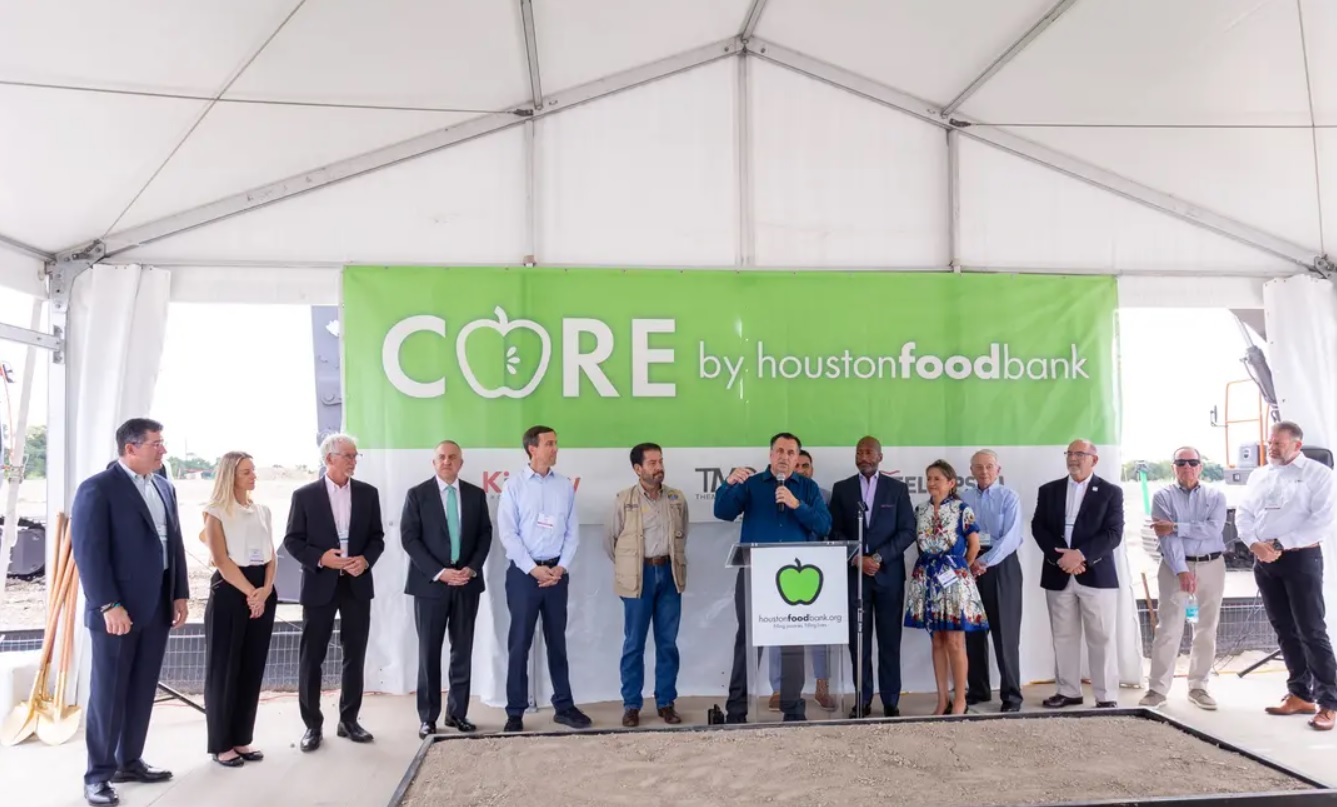
Houston Food Bank has broken ground on a new distribution and cold-storage hub in northwest Houston, adding a second major logistics platform to a regional network serving 18 counties across Southeast Texas.
The 310,000-square-foot distribution facility is being developed at 2121 W. Mt Houston Road as part of the food bank’s wider CORE project.
Texas construction records put the estimated cost of the broader development at $110 million.
The project will increase Houston Food Bank’s cold-storage capacity while adding space for food distribution, volunteer operations and disaster response. Initial operational capacity is expected in 2028.
The September 1 groundbreaking marks a major physical expansion for an organization that distributes food through a network of pantries, schools, soup kitchens and other community-service organizations.
It also follows several years in which warehouse capacity had become an operational constraint.
When Chevron donated the northwest Houston property in 2022, Houston Food Bank said periods of elevated demand associated with the pandemic, severe weather and inflation had forced it to use temporary warehouse space.
The organization said additional capacity for sorting, storing and distributing food could increase its ability to support the region.
That makes CORE as much a logistics expansion as a community-services project.
The new warehouse will expand Houston Food Bank’s distribution capacity across its 18-county service area, operating alongside its existing Portwall Street facility. Its additional cold-storage capacity will support an operation that handles fresh produce and other foods requiring more than conventional dry storage.
Houston Food Bank has not disclosed how much of the building will be refrigerated or frozen.
Pallet capacity, temperature zones, dock count, refrigeration technology and expected warehouse throughput also remain undisclosed. There is similarly no confirmed information establishing an ASRS, warehouse robotics, conveyor automation or other automated material-handling systems at the facility.
The project’s physical scale is clearer.
Community Impact reports the distribution facility at 310,000 square feet, while a Texas Department of Licensing and Regulation record lists 533,661 square feet for the overall CORE construction project.
Those figures represent different project scopes rather than interchangeable measurements of the warehouse.
The state filing describes a broader development containing an office and warehouse building as well as a four-story precast-concrete parking structure. The project also incorporates a welcome center, commercial kitchen, food hall, offices and conference facilities.
The TDLR record classifies the development as new construction and lists Kirksey Architects as the design firm.
Its construction schedule runs from August 3, 2026, through December 31, 2027, according to the state record.
That completion date differs from the expected operating timetable without necessarily conflicting with it. Houston Food Bank anticipates initial operational capacity in 2028, leaving a period between the state-recorded construction completion and the planned start of operations.
The organization has not disclosed a detailed commissioning schedule.
The 52-acre site was donated by Chevron and has been valued at approximately $10 million.
Located near Texas 249 and Ella Boulevard, the property gives Houston Food Bank a second large operating location in addition to its Portwall Street headquarters.
The organization has been preparing the site ahead of vertical construction. Its project updates document clearing, fencing and community engagement followed by earthwork and underground utility installation.
The expansion will significantly increase Houston Food Bank’s physical operating footprint.
Bank of America, which announced a $700,000 grant for the development earlier this year, said the northwest facility is expected to bring Houston Food Bank’s total operational footprint to approximately 613,000 square feet, effectively doubling it.
The project is not limited to warehouse operations.
CORE is being developed as a combined distribution and community-services campus, with plans also encompassing a commercial kitchen, health services, recreational facilities and other public-facing spaces.
For warehouse operations, however, the central change is additional capacity for receiving, storing and moving food through Houston Food Bank’s regional network.
Cold storage is particularly significant because additional temperature-controlled capacity expands the physical infrastructure available for handling perishable food.
The precise gain cannot yet be quantified. Houston Food Bank has not disclosed refrigerated or frozen square footage, pallet positions or an expected increase in annual food throughput.
The same caution applies to disaster logistics.
The organization expects the development to strengthen its disaster-response capabilities, but it has not published metrics for additional emergency inventory, truck capacity, dispatch volumes or response times.
Those omissions leave the operational specifications incomplete, but not the underlying rationale for the project.
Houston Food Bank’s own account of the expansion traces the need for another distribution facility to periods when demand strained existing warehouse capacity and temporary space became necessary.
CORE turns that temporary capacity problem into a permanent infrastructure investment.
With a 310,000-square-foot distribution facility, expanded cold storage and a state-filed construction estimate of $110 million for the wider development, the northwest Houston project will give the food bank a substantially larger physical platform for moving food across its 18-county network when initial operations begin in 2028.