

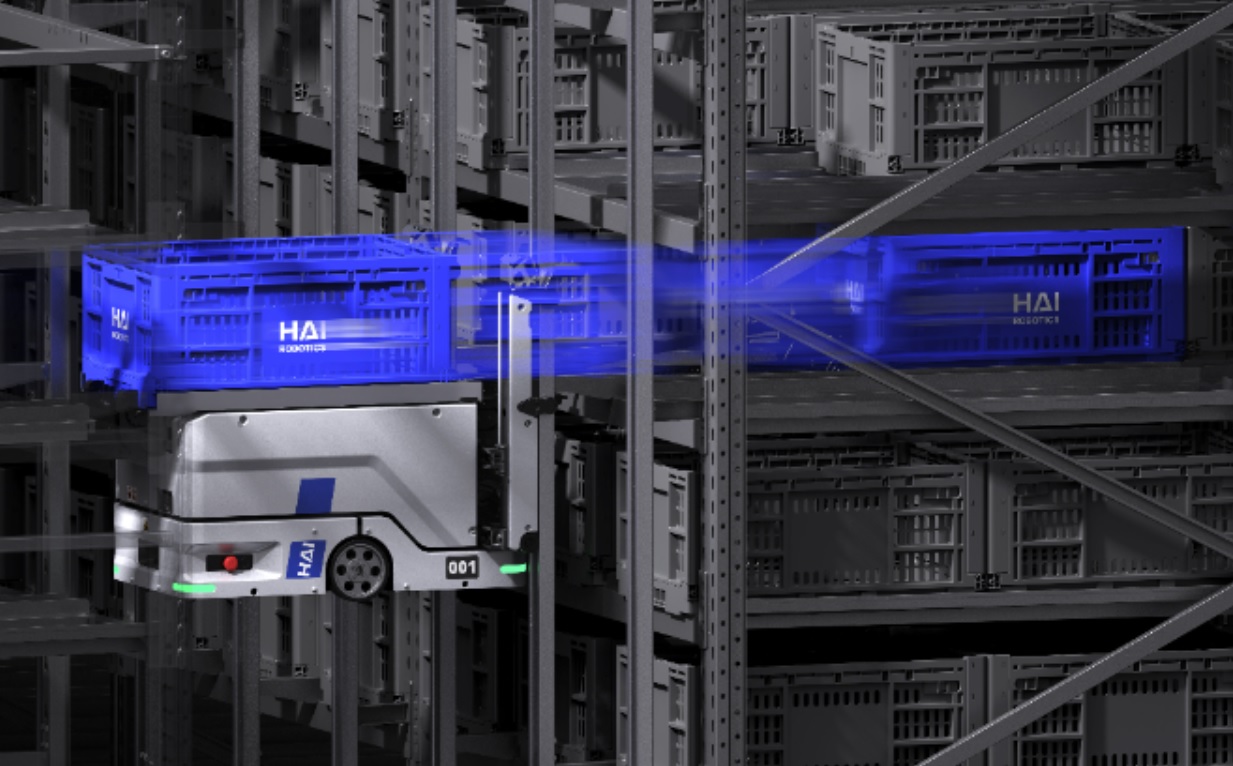
Hai Robotics says more than 10,000 rack-climbing robots have now been contracted for HaiPick Climb customer projects worldwide, giving the warehouse automation company a significant order milestone little more than a year after the system’s global introduction.
The robots are associated with projects across 12 countries in Asia, Europe, North America, South America and Australia.
The distinction between contracted and deployed units is important.
Hai Robotics has not said that all 10,000 HaiClimber robots have been manufactured, installed or placed into operation. It has also not disclosed how the contracted units are divided among individual projects or countries.
For U.S. warehouse operators, that leaves a particularly significant gap: North America is included in the project footprint, but Hai Robotics has not disclosed how many of the 10,000 robots are associated specifically with U.S. projects.
HaiPick Climb is a goods-to-person automated storage and retrieval system in which compact HaiClimber robots travel through the storage structure and move vertically on racks to retrieve totes.
That architecture differentiates the system from conventional autonomous mobile robots operating primarily at floor level and from more infrastructure-intensive ASRS configurations.
Hai Robotics began developing HaiPick Climb in 2022 and introduced it globally in 2025. The company says critical mechanisms underwent lifecycle endurance and aging testing before the commercial rollout.
The latest contracted-unit figure indicates substantial commercial uptake of the system internationally, although there is no independent audit of the 10,000-unit total.
Hai Robotics identified ANTA, Panasonic, Arvato, ITOCHU, METTLER TOLEDO and True Protein among customers using the technology. Projects span industries including apparel, ecommerce, healthcare, retail, automotive, grocery and consumer electronics.
The company did not identify which, if any, of those named HaiPick Climb projects are in the United States.
Repeat business provides another measure of adoption.
Founder and CEO Richie Chen said eight customers have either expanded existing HaiPick Climb installations or selected the system for additional projects.
Hai Robotics has not named those eight customers, disclosed their locations or said whether any are in the United States.
The company has continued developing the system as its contracted project base has expanded.
An upgraded HaiPick Climb configuration announced in March is specified by Hai Robotics to deliver totes to workstations in under two minutes and support as many as 4,000 tote deliveries per hour.
Those figures are vendor specifications rather than independently measured performance across the installed project base.
HaiQ, Hai Robotics’ software platform, coordinates functions including inventory, order flow and robot assignments within the system.
The company’s U.S. presence predates HaiPick Climb.
Hai Robotics maintains its Americas operation in Alpharetta, Georgia, and Georgia corporate records list Hai Robotics U.S.A. Inc. as an active company.
It has also previously deployed other members of the HaiPick automation family at U.S. fulfillment operations.
Avenue Shops installed a HaiPick system at its apparel fulfillment operation in Lindon, Utah. Hai Robotics has reported that the project reduced the operation’s storage footprint while increasing storage capacity and daily orders shipped.
Those performance figures come from the vendor’s case study and have not been independently verified.
More importantly, the Utah installation predates HaiPick Climb’s 2025 global introduction and should not be counted as evidence of a U.S. HaiPick Climb deployment.
Hai Robotics separately documents a HaiPick System 3 installation at Win.IT America’s Los Angeles fulfillment center, where autonomous case-handling robots work with ground-level companion robots.
That project likewise demonstrates Hai Robotics’ existing U.S. customer footprint, but it does not establish that Win.IT America accounts for any of the 10,000 HaiClimber robots now under contract.
Hai Robotics has also expanded its involvement with the U.S. material-handling industry. The company joined MHI’s Automated Storage and Retrieval Systems Industry Group in 2023 and its Mobile Automation Group in 2025.
Together, those activities establish that Hai Robotics is already participating in the U.S. warehouse automation market.
What they do not establish is the American share of HaiPick Climb’s latest growth.
The 10,000 contracted robots therefore provide a clearer indicator of the system’s global commercial pipeline than of its current installed base — and an even less precise measure of U.S. adoption.
The milestone nevertheless moves HaiPick Climb beyond the scale of a handful of demonstration projects. Combined with repeat or expansion orders from eight customers, it indicates that rack-climbing goods-to-person automation is being specified across multiple countries and warehouse sectors.
How rapidly that architecture is moving into American facilities remains harder to determine.
Hai Robotics has not disclosed the number of U.S. HaiPick Climb customers, project locations, contracted units or operational robots.