

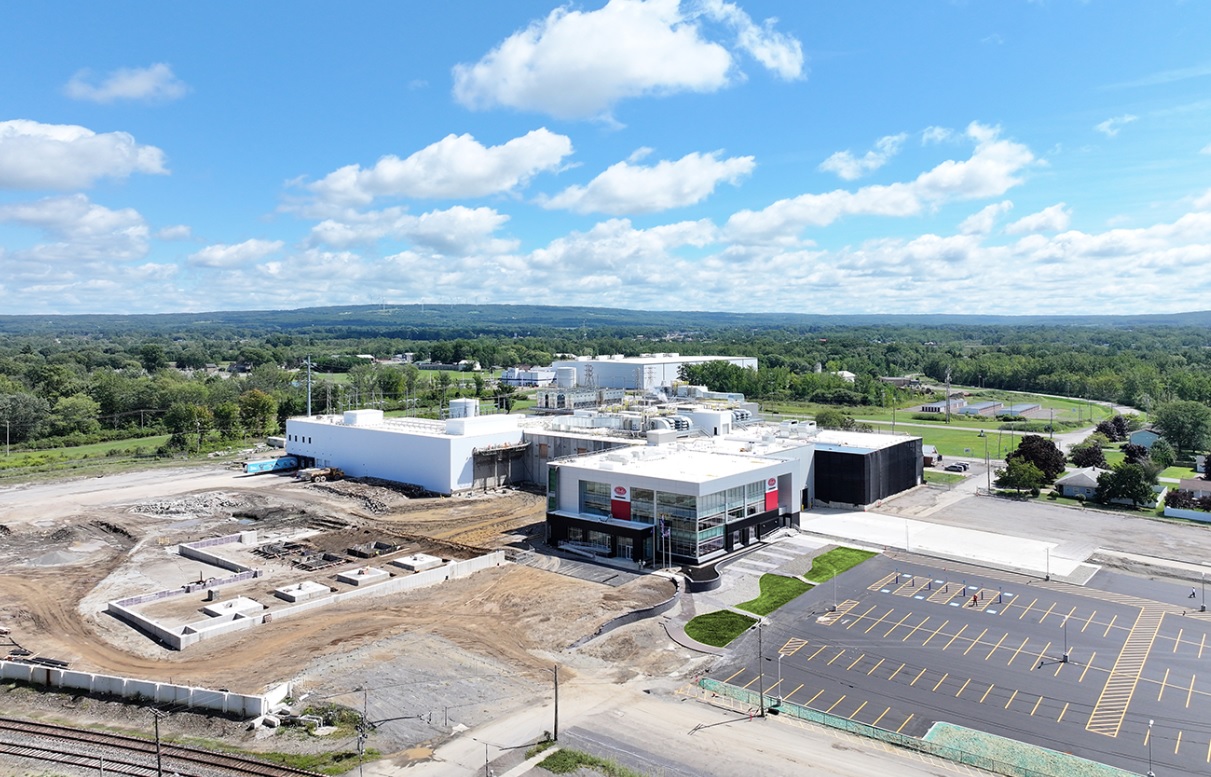
Wells Enterprises has added freezer capacity at its Dunkirk, New York, ice cream plant as the company moves through a $425 million manufacturing expansion designed to increase annual production capacity fivefold.
The ice cream manufacturer has completed the first two phases of the four-phase project, which began construction in 2024 and is scheduled for full completion in 2028.
The work completed so far includes infrastructure for new production lines, additional freezer capacity, a new chocolate manufacturing operation and a three-story employee center.
For cold-chain operators, the freezer component is only one part of a broader frozen-food logistics system developing around the plant.
Wells’ on-site expansion is being paired with continued use of a separate Americold cold-storage distribution facility in Dunkirk, according to New York State. That arrangement creates distinct manufacturing-side and external distribution capacity as Wells prepares for substantially higher frozen-product output.
The $425 million figure applies to the entire Wells transformation. The company has not disclosed how much of that investment is allocated specifically to freezer or other cold-chain infrastructure.
It has also not provided the freezer’s square footage, pallet capacity, temperature range, refrigeration technology or storage configuration.
Those omissions make the scale of the cold-storage component difficult to quantify even as the wider manufacturing expansion is substantial.
When all four phases are finished, Wells expects the Dunkirk operation to total approximately 350,000 square feet and run between 11 and 15 production lines.
Annual production capacity is expected to reach approximately 20 million cases, compared with around 4 million cases previously.
That production increase does not translate directly into an equivalent increase in storage requirements. Wells has not disclosed finished-goods dwell times, daily pallet output, inventory levels or the amount of product expected to move through its on-site freezer versus external cold storage.
The company’s continued relationship with Americold provides an important part of that logistics picture.
When New York announced the enlarged Wells project in 2024, state officials said the manufacturer would continue using Americold’s separate cold-storage distribution facility in the Town of Dunkirk.
The state valued the Americold project at approximately $41 million and said it was expected to create 60 full-time jobs.
The two investments should not be combined.
Wells’ $425 million project covers a much broader manufacturing transformation, while the $41 million figure relates separately to Americold’s dedicated cold-storage operation.
Together, however, they show how the expansion of frozen-food manufacturing in Dunkirk extends beyond production equipment alone.
Wells is increasing freezer capacity within the manufacturing site while retaining access to external cold-storage distribution infrastructure. The available sources do not specify how product will be divided between those two components or what volumes will transfer between them.
The Wells project itself has grown substantially since it was first announced.
The expansion was initially valued at $250 million in 2023. By July 2024, the planned investment had increased by $175 million to $425 million as the company enlarged the scope of the Dunkirk operation.
New York State committed up to $12 million in Excelsior Jobs Program tax credits and a $6 million Empire State Development grant under the expanded plan, subject to investment and employment commitments.
Wells expects the project to create 270 permanent jobs over several years. State officials previously said the enlarged investment would also retain approximately 380 existing positions.
The company has not disclosed how many of the 270 planned jobs have been filled so far.
The first two phases also introduce a new chocolate manufacturing operation that combines Wells’ ice cream production with Ferrero confectionery capabilities. Wells, which is part of the Ferrero Group, describes the operation as the only Ferrero facility of its type in the United States.
New production lines and capabilities associated with the expansion began operating in late 2025.
Phase 3 is now underway and will add further production lines. The fourth and final phase is expected to increase processing capabilities, including raw-material handling, ahead of the targeted 2028 completion.
Wells says the transformed plant incorporates proprietary technology and customized manufacturing capabilities, but it has not identified the production or refrigeration equipment suppliers.
There is also no disclosed evidence of automated storage and retrieval systems, robotic pallet handling or other warehouse automation within the freezer operation.
That leaves the physical cold-chain design largely undisclosed despite its growing importance to the plant.
At the planned 20-million-case annual production level, Dunkirk will have considerably more frozen product moving through its manufacturing operation than before. Wells has responded by adding freezer capacity on site while retaining a separate cold-storage distribution resource through Americold.
How those two facilities divide storage, staging and distribution responsibilities will be an important operational detail as the remaining phases come online.
For now, the project demonstrates that Wells’ fivefold manufacturing-capacity target is being supported by cold-chain infrastructure both inside and outside the factory. What remains unknown is the scale of that freezer capacity — and how much additional frozen storage and distribution throughput the completed plant will ultimately require.