

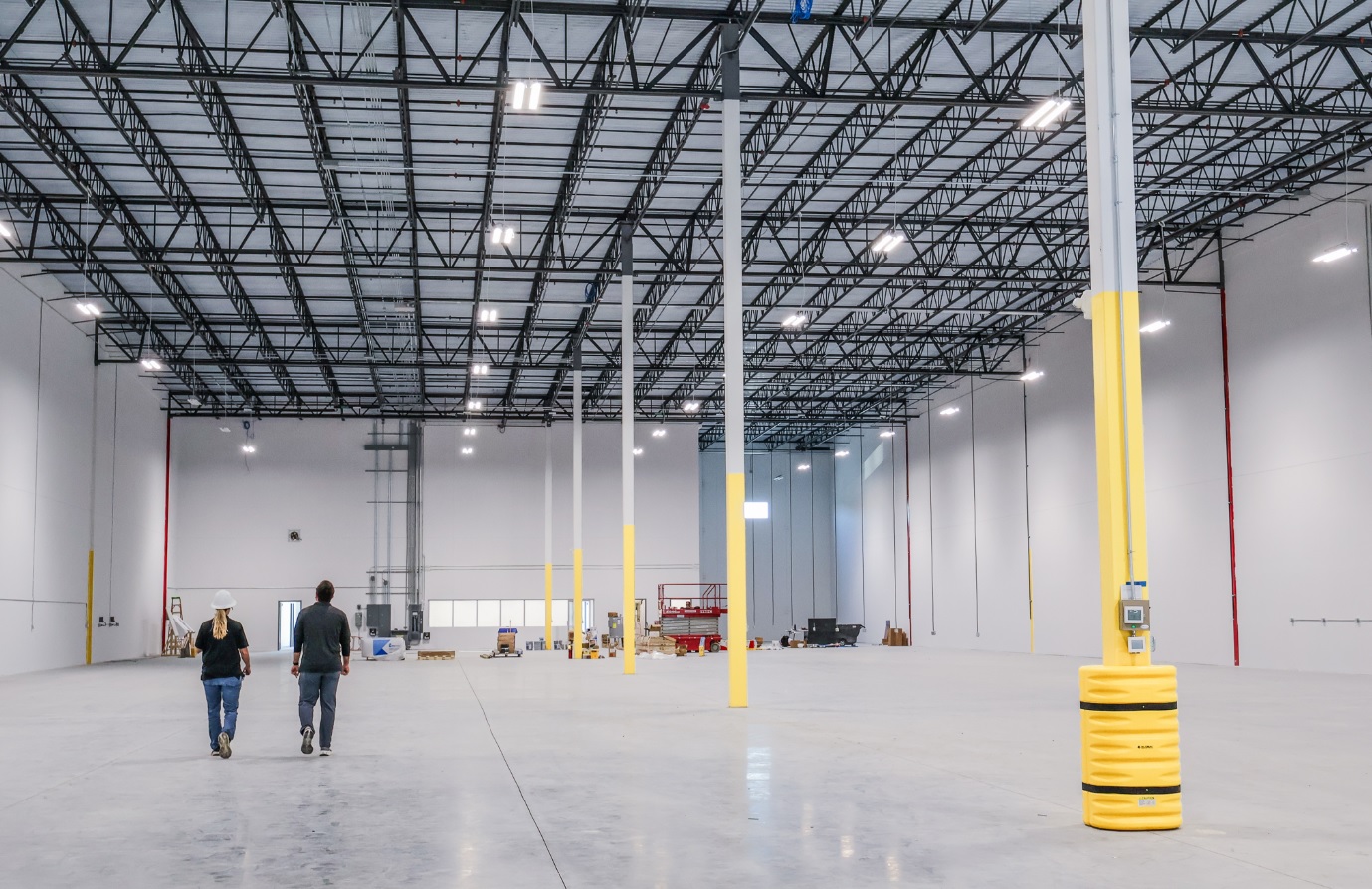
Warehouse automation trials can become considerably more complicated when equipment moves from a demonstration into a working distribution center. Kenco is tripling the size of its Chattanooga technology lab to give operators and equipment manufacturers more room to test systems before reaching that stage.
Kenco says it plans to open a 30,000-square-foot Innovation Lab at 4885 Claude Ramsey Parkway, replacing its existing 10,000-square-foot physical test facility. According to the company, a ribbon cutting is scheduled for September 10.
Kenco says the larger facility will accommodate more technologies as well as bigger and more complex automation systems, with manufacturers and customers able to evaluate equipment in an environment designed to resemble warehouse operating conditions.
The expansion builds on a technology-testing program Kenco established in 2015. That program moved into a dedicated 10,000-square-foot warehouse-style testing facility in 2019, creating a location where equipment could be evaluated away from live customer operations.
The threefold increase in floor space extends that model at a time when warehouse operators face a basic automation challenge: determining whether technology demonstrated by a supplier will work with the physical flows, software and processes of a specific operation.
Kenco is positioning the new lab as vendor-neutral. Ainsley Williams, the company’s vice president of Automation & Innovation, said the additional space will give original-equipment manufacturers more room to experiment while allowing customers to explore potential applications before committing to their own investments.
Vendor neutrality, however, should not be confused with independent certification. Kenco has not disclosed the testing methodology that will be used at the new facility, whether results will be independently audited or whether competing systems will be benchmarked against common performance criteria.
Nor has it named the OEMs or technologies that will be installed when the facility opens.
Kenco’s earlier lab provides some indication of the range of systems its testing program has covered. When the 10,000-square-foot facility was announced in 2019, the company identified autonomous mobile robots, autonomous material-handling software, vision-assisted picking technology and warehouse management systems among the technologies being evaluated.
Those suppliers and systems have not been confirmed for the new facility.
The larger footprint potentially broadens the physical scope of testing. Automation projects can require sufficient space to reproduce material flows, equipment interactions, process sequences and operator movements, particularly when evaluating systems that extend beyond individual robots or software demonstrations.
The extent to which Kenco will reproduce live operating conditions remains unclear. The company has not said whether customers will test their own inventory, process representative order profiles, connect production-level warehouse software or run equipment for extended periods.
Those details matter because a warehouse-style test environment is not the same as a live distribution center, where equipment performance can be affected by changing order profiles, exceptions, congestion, system integrations and interaction with employees.
Kenco’s own research provides some context for its investment in pre-deployment evaluation.
In a 2026 survey of more than 150 North American supply-chain executives, 42% of respondents told Kenco they preferred established technologies, while 43% favored a combination of established and emerging technology. Cost constraints were identified as an innovation barrier by 51% of respondents, and 29% cited technology integration.
Those are Kenco-generated survey findings rather than independent industry statistics, but they point to a practical issue for technology buyers: enthusiasm for automation still has to survive questions about cost, integration and operational fit.
The lab also extends Kenco’s role beyond operating distribution and transportation networks. By providing physical infrastructure for technology evaluation, the 3PL is seeking a position earlier in customers’ automation decisions, before equipment reaches a live warehouse.
Whether that testing translates into better deployments will depend on how the facility is operated. Kenco has not disclosed its capital investment in the expansion, the number of test areas, lab staffing, annual testing capacity or how results will be measured and reported.
Those omissions leave the most important test of the expanded facility for September and beyond: not how much additional floor space Kenco has created, but how rigorously that space can be used to evaluate automation before customers commit it to day-to-day warehouse operations.