

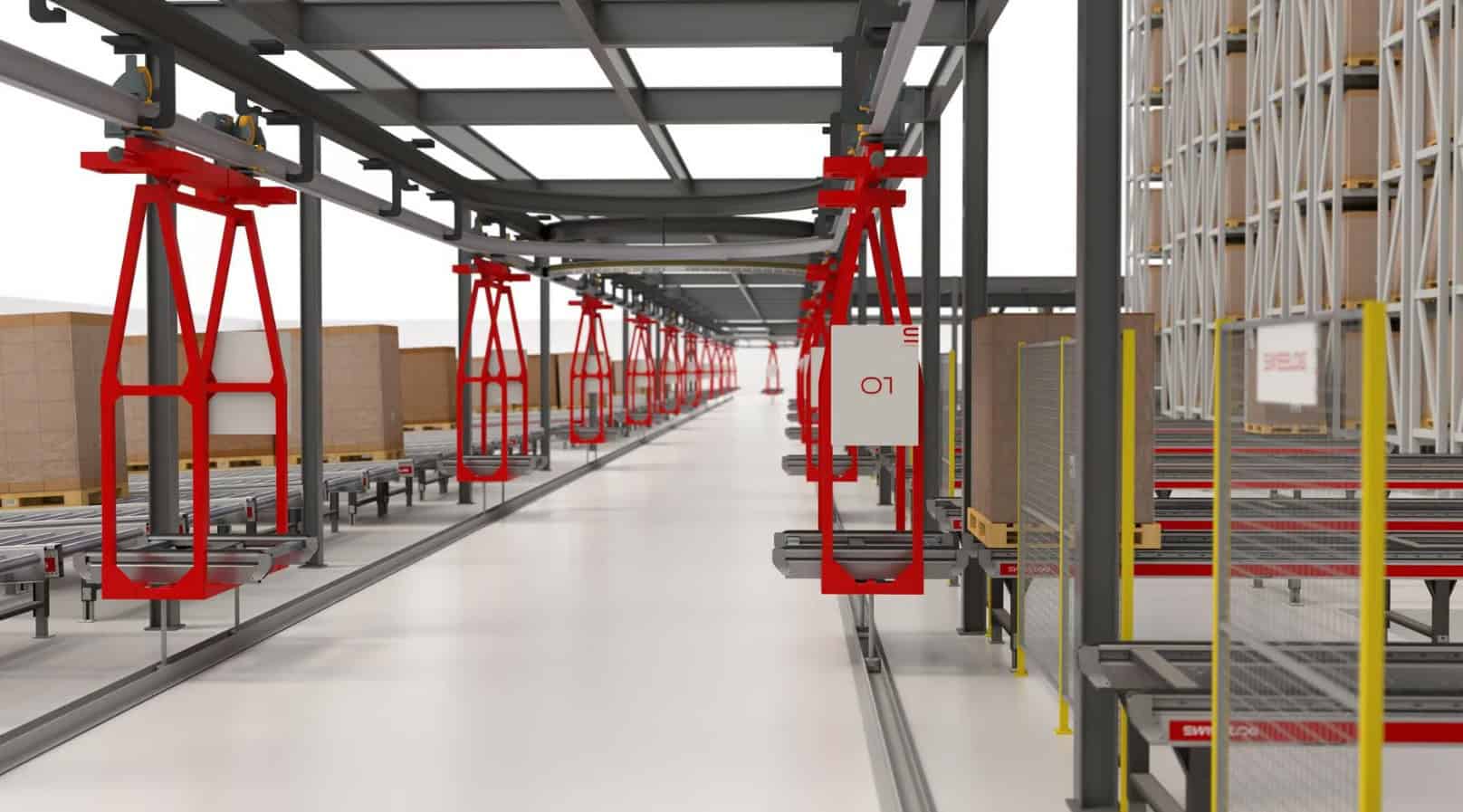
Moving pallets quickly across large automated warehouses does not always require more fixed conveyors. Swisslog is putting renewed emphasis on another approach: independently moving vehicles running on an electrified monorail.
The warehouse automation supplier has repositioned its established monorail technology under the FastMove name, specifying speeds of up to 2 metres per second and capacity exceeding 600 pallets per hour.
Despite the new identity, FastMove is not an entirely new transport platform. Swisslog says the underlying monorail technology has more than 40 years of operational history, making the July launch an evolution of an existing architecture rather than a clean-sheet product introduction.
That distinction matters for warehouse operators evaluating the technology. Alongside higher-throughput applications, Swisslog is positioning FastMove as a modernisation path for existing monorail users, with upgrades focused primarily on controls and software, and mechatronic components replaced where necessary.
According to the company, that could allow some installations to be updated without replacing the complete transport system.
FastMove is designed for horizontal pallet movement over longer distances, connecting warehouse processes including automated storage, production, receiving, buffers and shipping. Track can be suspended or floor-mounted and configured with straight sections, curves and switches.
Rather than relying on continuous conveyor sections to move every pallet, the system uses vehicles travelling around the monorail circuit. Swisslog says throughput can be expanded by changing the number of vehicles operating on the track, allowing operators to phase additional transport capacity as requirements change.
The company does not, however, publish a capacity curve showing how throughput changes as vehicles are added. Nor has it disclosed how many vehicles, what track length or which routing conditions underpin its stated capacity of more than 600 pallets per hour.
Those variables are important when assessing the headline specification. A maximum vehicle speed of 2 metres per second does not by itself determine end-to-end pallet cycle time, which will also depend on handovers, routing, switches, congestion and the configuration of the wider automated system.
FastMove can carry loads of up to 1,500 kg, rising to 3,000 kg with twin-load elements. Its specified operating range extends from -30°C to +50°C, making the system applicable to environments ranging from frozen storage to conventional ambient warehouses.
Pallets can be transferred to roller or chain conveyors, while FastMove can connect with Swisslog’s Vectura crane-based AS/RS, PowerStore pallet shuttle system and AgileStore offering. Control is integrated with the company’s SynQ software platform.
The monorail therefore functions as a transport layer within a broader automation architecture rather than as a storage system in its own right.
Swisslog is also positioning FastMove as an alternative to conventional pallet conveyors for long-distance, high-throughput movements. The company says the monorail can achieve a more favourable cost position by transporting large volumes with fewer system components, reducing installation and operating costs.
No independent cost comparison or lifecycle model was disclosed, so the economics will depend on the application. Transport distance, required throughput, layout, redundancy and maintenance strategy can all influence the choice between monorail and conveyor architectures.
Existing Swisslog projects illustrate how the underlying technology can operate alongside, rather than simply instead of, other forms of automation.
A Mondelēz warehouse project announced in 2025 incorporates an inverted monorail circuit with 22 dual-load trolleys alongside 11 Vectura cranes and 490 metres of pallet conveyor. The automated warehouse has more than 56,000 pallet locations, according to Swisslog.
In temperature-controlled logistics, a frozen-food project for Gias in Italy uses a 150-metre monorail to connect the automated warehouse with production, incoming goods and a shipping buffer.
An older Galbani cheese installation provides an example over a greater distance. Swisslog describes that operation as using 1.2 kilometres of monorail in a temperature-controlled warehouse handling as many as 9,000 pallets per day.
Those projects do not independently validate FastMove’s current performance claims, but they demonstrate that the transport architecture behind the new product identity has been deployed at commercial scale.
The product’s next development will also involve its control environment. Swisslog plans another release by the end of 2026 that it says is being designed around requirements associated with the European Union’s Cyber Resilience Act and machinery regulations.
The Cyber Resilience Act becomes generally applicable on 11 December 2027. Chapter IV has applied since 11 June 2026, while Article 14 reporting obligations take effect on 11 September 2026, bringing cybersecurity requirements for products with digital elements into force in stages.
For warehouse operators, FastMove therefore represents two propositions under one new product name: an alternative architecture for high-throughput pallet movement in new automation projects and an upgrade path for existing Swisslog monorail installations.
What remains less clear is the economics behind that choice. Swisslog has not published installed pricing, energy consumption, independent throughput testing, retrofit downtime or the operating assumptions behind its 600-plus-pallet-per-hour figure — information that would be needed for a project-level comparison with conventional pallet conveyor.