

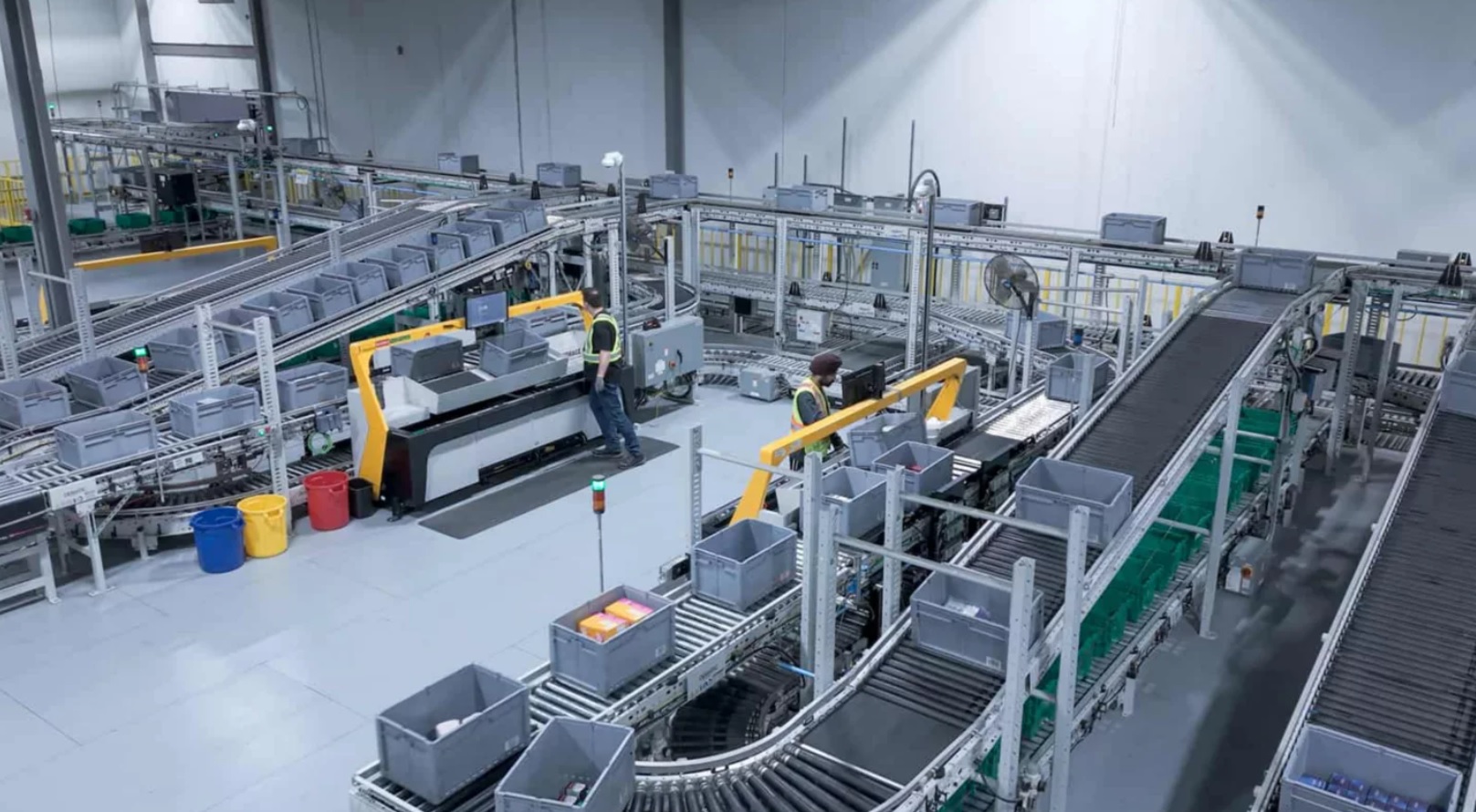
Pattison Food Group has expanded automation at its 485,000-square-foot ambient grocery distribution centre in Langley, British Columbia, deploying a high-density goods-to-person fulfilment system designed to support store orders across multiple retail banners in Western Canada.
The project, supplied by Dematic, centres on a nine-aisle Multishuttle automated storage and retrieval system with nearly 62,000 automated storage locations, supported by 16 goods-to-person workstations and a RapidPick solution. According to Dematic, the installation is intended to improve split-case fulfilment, increase throughput capacity and reduce manual handling, although the companies have not disclosed measured operational results.
The distribution centre supports nine Pattison Food Group grocery banners, including Save-On-Foods, PriceSmart Foods and Quality Foods. The companies did not identify the remaining banners or disclose how many stores are supplied from the Langley facility.
Unlike conventional pallet-based warehouse operations, the installation is designed to handle both split-case and full-case grocery fulfilment. Split-case operations require warehouses to assemble store-specific orders by selecting individual product quantities rather than entire shipping cases, increasing the complexity of inventory management and order sequencing across large SKU ranges.
According to Dematic, the automated storage system manages approximately 11,000 ambient grocery stock-keeping units, with the Multishuttle retrieving inventory to operator workstations instead of requiring employees to travel through warehouse aisles. While goods-to-person systems can reduce picker travel and centralise order assembly, Dematic has not released throughput, productivity or labour-performance data for the Langley operation.
The automation extends beyond storage and picking. The project integrates decanting, conveyor systems, sortation, tote handling, buffering and sequencing, with Dematic software coordinating material flow between receiving, storage, picking and order consolidation. The company did not identify the specific warehouse software deployed or explain how it integrates with Pattison Food Group’s existing warehouse management or enterprise systems.
Reusable totes also form part of the operation. Dematic says the system supports Pattison Food Group’s sustainability initiatives by reducing reliance on single-use packaging, although neither company has quantified packaging reductions, waste avoidance or associated environmental benefits.
To support long-term operation, the project includes resident maintenance, lifecycle services and ongoing technical support. However, Dematic has not disclosed maintenance staffing levels, service agreements, uptime commitments or system availability, making it impossible to independently assess the installation’s operational resilience.
Mike Olson, senior vice president of supply chain and wholesale at Pattison Food Group, said the retailer selected Dematic because of its grocery automation expertise and the flexibility of its fulfilment systems to support future growth. Alexandre Guiard, senior vice president of business solutions for the Americas at Dematic, said increasing complexity in grocery distribution is driving demand for integrated software and automation capable of adapting to changing operational requirements. Those comments reflect the companies’ assessment of the project rather than independently verified operating performance.
The scale of the installation suggests Pattison Food Group is investing in automation to manage the growing operational demands of ambient grocery distribution, where large SKU counts, split-case picking and store-specific replenishment create greater fulfilment complexity than conventional full-case warehouse operations. Whether the project delivers the efficiency, throughput and accuracy improvements outlined by Dematic will depend on performance data that has yet to be disclosed.