

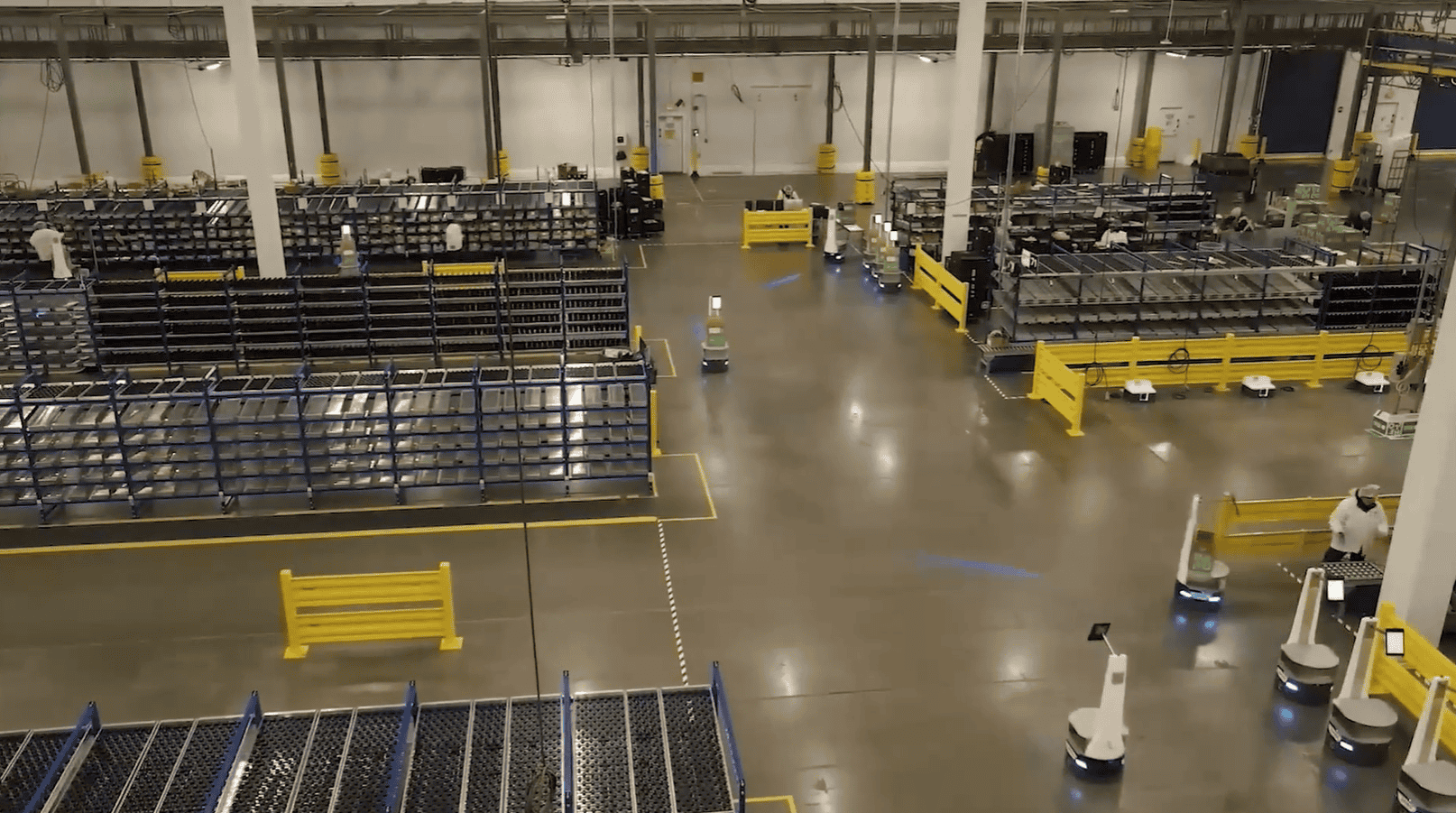
Expanding product choice within refrigerated fulfilment centres presents a difficult balancing act for meal-kit operators. Increasing the number of chilled stock keeping units (SKUs) typically requires more storage capacity while adding operational complexity and maintaining strict cold-chain requirements.
HelloFresh has addressed that challenge by deploying customised autonomous mobile robots (AMRs) from Locus Robotics that increased chilled fulfilment capacity from 100 to 500 SKUs, according to the companies. Rather than redesigning warehouse infrastructure, the project focused on adapting robotic hardware for temperature-controlled operations, enabling a fivefold increase in refrigerated product capacity.
The deployment began in July 2025 with 13 Locus Origin robots supporting Factor, HelloFresh’s prepared-meal brand. Following the initial pilot, the installation expanded by a further 26 robots within three months after the system’s performance was validated. Support for EveryPlate fulfilment is planned as the rollout extends across HelloFresh’s wider brand portfolio.
The robots currently operate across approximately 12,000 square feet of chilled fulfilment space. Locus reported an average mission time of three minutes and 36 seconds from order induction to drop-off, reflecting the importance of minimising product dwell time in refrigerated environments. The companies did not disclose broader productivity improvements or order throughput.
The phased rollout also reflects a growing preference among warehouse operators to test automation through targeted proof-of-concept deployments before committing to larger-scale projects. HelloFresh said it evaluated a broader automation programme involving two additional providers before selecting a focused deployment with Locus Robotics.
For temperature-controlled distribution, flexible automation is becoming increasingly attractive as grocery, meal-kit and fresh food businesses expand product ranges while seeking to avoid extensive modifications to existing warehouse layouts. Unlike fixed conveyor systems, autonomous mobile robots can generally be introduced in stages and adapted as fulfilment requirements evolve.
Locus said the customised solution reduced dependence on fixed conveyor infrastructure, although it did not quantify the operational impact. HelloFresh Vice President of Operational Excellence Brad Mesloh said the expanded automation would allow the business to offer customers more meal choices while maintaining fulfilment accuracy and speed.
The announcement did not disclose the deployment’s location, investment value, labour impact, warehouse management system integration or expected financial return. Those details remain undisclosed.
Locus Robotics provides warehouse automation through a Robots-as-a-Service (RaaS) model and says its systems are deployed across more than 350 facilities serving over 150 brands worldwide. The HelloFresh project illustrates how warehouse automation suppliers are adapting AMR technology for refrigerated environments, where deployment flexibility and phased implementation can be as important as automation performance.