

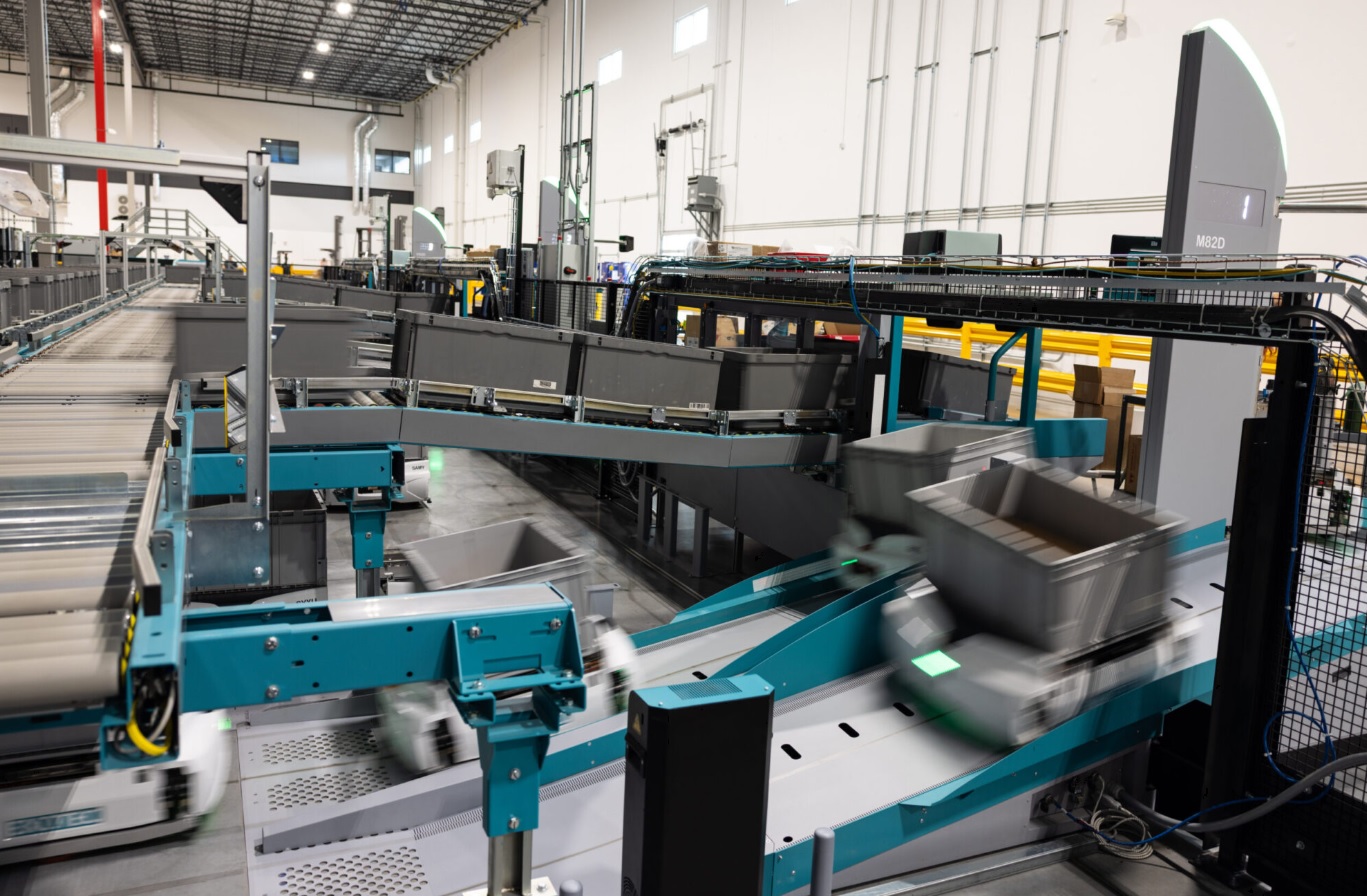
First Supply’s automated distribution center in West Salem, Wisconsin, uses 31 Exotec Skypod robots to accelerate order picking and support a 5 p.m. cutoff for next-morning fulfillment.
Exotec’s Skypod robots are helping wholesale distributor First Supply accelerate order picking at its Wisconsin distribution center, where the company reports processing speeds up to 10 times faster than its previous manual operations.
The robotic system operates at First Supply’s Joe Poehling Distribution Innovation Center in West Salem, a facility the company describes as covering 308,000 square feet. The warehouse combines automated storage and retrieval with conventional pallet handling to distribute plumbing, HVAC, waterworks, lighting and other building products.
Exotec disclosed the performance results on October 6, 2026, more than a year after the facility began operations in May 2025. The announcement concerns the performance of an existing robotic installation rather than a new warehouse automation contract.
The supplier attributes the improvement to its goods-to-person picking system, which retrieves stored products and delivers them to operator workstations. The reported tenfold gain has not been independently audited, and the available disclosures do not provide comparable picking rates in picks per hour.
Exotec Skypod System Uses 31 Robots and More Than 50,000 Bins
The West Salem warehouse uses 31 autonomous Skypod robots operating within a high-density storage and retrieval system.
According to Exotec’s technical case study, the installation contains more than 50,000 storage bins arranged in racks reaching approximately 38 feet. First Supply has separately reported approximately 53,000 bins at the facility.
The robotic system delivers inventory bins to three picking stations, where operators assemble orders without having to travel through conventional storage aisles.
The installation also includes six packing stations, 12 destination sortation lanes and a return lane. Induction equipment and a bin-compaction station support the movement and management of inventory within the automated system.
Warehouse management software coordinates inventory information and order processing with the robotic equipment.
The automation does not handle every product stored at the facility. More than 12,000 conventional pallet locations accommodate larger items, including water heaters, condensers and furnaces, that are unsuitable for bin-based storage.
Additional equipment includes dimensioning systems, robotic pallet wrappers and conventional order-picking equipment.
The resulting configuration allows First Supply to use robotic retrieval for smaller products while retaining traditional material-handling processes for bulky inventory.
Faster Picking Supports 5 P.M. Order Cutoff
The automated picking operation supports First Supply’s ability to accept orders until 5 p.m. for next-morning fulfillment.
Under the operating model described by Exotec, orders received before the cutoff can be picked, packed and consolidated for overnight transportation to the company’s distribution branches.
The process allows products to become available for branch replenishment the following morning. Published information does not establish that every order is delivered directly to its final customer by that time.
According to Exotec, next-day orders can account for as much as 20% of the distribution center’s daily order volume.
The Skypod system reduces the travel associated with manual picking by bringing inventory directly to operator workstations. This allows picking activity to take place within a concentrated area rather than requiring employees to move between multiple storage locations.
For First Supply, the reported improvement is particularly relevant to the short processing window between the late-afternoon order cutoff and overnight dispatch.
However, the disclosed figures do not establish how the increase in picking speed translates into overall warehouse throughput, labor productivity or fulfillment costs.
Wisconsin Facility Began Operations in May 2025
First Supply began operating the West Salem distribution center in May 2025, following a construction and systems implementation program that started in 2024.
The company formally dedicated the facility as the Joe Poehling Distribution Innovation Center in September 2025.
The warehouse supports a centralized inventory and distribution model, handling branch replenishment and e-commerce fulfillment across First Supply’s regional network.
First Supply reports a facility area of 308,000 square feet. Design-build contractor MSI General separately lists the building at 325,289 square feet. The difference has not been reconciled and may reflect differing measurement conventions.
The warehouse integrates robotic storage with conventional pallet handling, packing and outbound sortation, allowing different product categories to move through appropriate fulfillment processes.
The robotic system is therefore one component of a broader distribution operation rather than a fully automated warehouse in which all inventory is handled by robots.
Exotec Identifies Additional Storage and Throughput Capacity
The installed Skypod system also provides capacity for future expansion.
According to Exotec, storage capacity could increase up to fourfold within the existing racking footprint. This represents potential capacity rather than an expansion already completed.
The supplier also reports that adding bins and robots could increase system throughput by approximately 30%.
These figures describe different aspects of the installation. The fourfold estimate concerns potential storage capacity, while the 30% figure refers to additional processing throughput.
The system currently handles more than 14,000 stock-keeping units, according to Exotec’s October announcement.
First Supply’s West Salem property also provides space for possible physical expansion, although the October operational update does not establish a new construction phase.
Productivity Gains Remain Supplier-Reported
The reported improvement in picking performance illustrates how goods-to-person robotics can change order-processing operations in wholesale distribution.
By transporting inventory to fixed workstations, robotic storage and retrieval systems can reduce employee travel and concentrate picking activity within a smaller operating area.
At First Supply, this approach operates alongside conventional pallet storage, reflecting the different handling requirements of smaller components and larger building products.
The company’s reported performance gains are linked to faster picking and the ability to maintain a late order cutoff while preparing shipments for overnight distribution.
However, the available disclosures do not provide independently audited productivity measurements, a consistent picks-per-hour comparison or a quantified return on investment.
The standalone capital investment in the Exotec installation has also not been established in the sources reviewed.
Without those figures, the financial impact of the automation cannot be independently assessed.
The West Salem facility nevertheless provides a detailed operating example of how robotic picking can be integrated into a wholesale distribution center that continues to rely on conventional pallet handling for part of its inventory.