

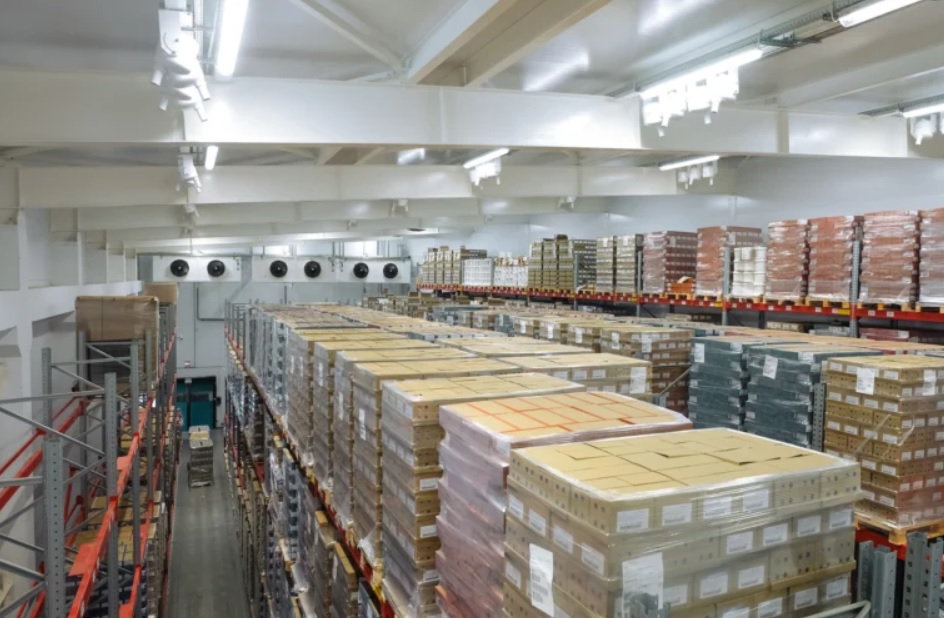
For refrigerated warehouse operators, dealing with inventory that can no longer be sold or donated creates a logistics process of its own: products have to be removed from storage, securely destroyed, documented, and routed to an appropriate destination.
United States Cold Storage is using anaerobic digestion as one of those destinations in California. Seven of the company’s facilities have sent more than 2.5 million pounds of unsold food and beverages to Divert for processing during the first 15 months of a waste-diversion program.
The material is transported to Divert’s Integrated Diversion & Energy Facility in Turlock, where packaged products are separated using the company’s High-Recovery Depackaging technology before the organic material enters anaerobic digestion.
Divert reported that the 2.5 million pounds of material generated more than 8,500 MMBtu of renewable natural gas, which is delivered into the gas pipeline. The process also produces fertilizer and soil amendments for agricultural use, as well as recovered water.
The company estimates that the program avoided approximately 450 metric tons of CO2-equivalent emissions during the period. That figure is Divert’s calculation; the announcement does not disclose the underlying carbon-accounting methodology, baseline disposal scenario or third-party verification.
Importantly, the program sits downstream of food recovery rather than replacing it. Divert says products are sent for processing only after attempts to sell or donate them have been exhausted. US Cold has separately described the partnership in similar terms, saying the program handles food and beverage products that can no longer be sold or donated.
That sequencing matters in California. Under the state’s SB 1383 framework, California established targets to reduce organic-waste disposal by 75% and recover 20% of edible food otherwise destined for disposal by 2025. CalRecycle also requires covered commercial edible-food generators to arrange recovery of the maximum amount of qualifying edible food for human consumption.
The US Environmental Protection Agency follows a similar hierarchy. Its Wasted Food Scale places prevention and donation above anaerobic digestion, while still identifying digestion with beneficial use of the resulting material as preferable to landfill disposal.
For cold-storage operators, that positions anaerobic digestion as an end-of-life pathway for inventory that can no longer be sold or donated, rather than a substitute for waste prevention or food donation.
The California program also shows how the disposal process can extend beyond the warehouse. US Cold identifies inventory requiring destruction, material is transported to Turlock, packaging is separated, organic content is digested and the resulting outputs enter energy and agricultural supply chains. Divert says the service also provides secure product destruction and documentation for US Cold and its customers.
Oatly is among the brands whose inventory has moved through the program. Divert reported processing 126,000 pounds of Oatly product, generating nearly 80 MMBtu of renewable gas and avoiding approximately four metric tons of CO2e. As with the wider program, the emissions figure is company-reported rather than independently verified.
The California initiative is not US Cold’s only approach to recovering unsellable inventory. The cold-storage operator reported in July that its Texas operations had diverted more than 10 million pounds of unsellable organic material from landfill through a composting program with The Organic Recycler since August 2024. Together, the two disclosed programs show US Cold using different recovery pathways in California and Texas.
Anaerobic digestion itself is an established waste-processing method. EPA describes it as the decomposition of organic material in an oxygen-free environment, producing biogas that can be used for energy and a nutrient-rich digestate that can be beneficially used as fertilizer or soil amendment.
What remains unclear is the commercial and operational impact on the cold-storage network. Neither Divert nor US Cold disclosed the program cost, transportation distances, number of truckloads, comparison with previous disposal costs or effect on warehouse capacity and labour. Divert also did not disclose how much fertilizer or recovered water was actually produced from the 2.5 million pounds processed.
Those gaps limit conclusions about the economics of the model. But the program illustrates a broader operational issue for temperature-controlled logistics: responsibility for customer inventory does not necessarily end when that inventory becomes unsellable. Managing its secure destruction, documentation and movement to a recovery destination can remain part of the cold-chain process.